1.9 Required practical: antibiotics and antiseptics on bacteria
How to investigate the effect of antibiotics or antiseptics on bacterial growth using agar plates: the method, variables, measuring zones of inhibition, calculating their area with pi r squared, and evaluating the results.
The practical
Key terms
- Antibiotic: a drug that kills bacteria (or stops them growing) inside the body. It does not work on viruses.
- Antiseptic: a chemical used on the skin or a wound to kill microorganisms.
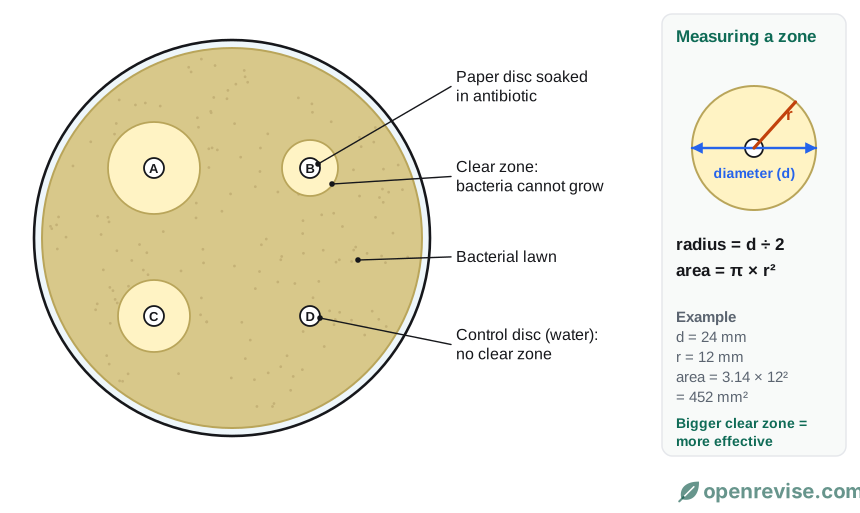
- Zone of inhibition: the clear area around a disc where bacteria have not been able to grow.
- Control: a test in which the factor you are investigating is left out, so you can see what it does.
- Reliable: giving similar results when the investigation is repeated.
Aim: to investigate the effect of different antibiotics, antiseptics (or different concentrations of one) on bacterial growth, using agar plates and measuring zones of inhibition.
Method
Use aseptic technique throughout.
- Spread bacteria evenly over a sterile agar plate with a sterile spreader, to make a lawn of bacteria.
- Use sterile forceps to place small discs of filter paper, each soaked in a different antibiotic or antiseptic, on the agar. Space them out.
- Add a control disc soaked in sterile water.
- Tape the lid on, turn the dish upside down and incubate at 25 °C for 24 to 48 hours.
- Without opening the dish, measure the diameter of each clear zone in mm.
- Work out the radius (diameter ÷ 2) and then the area of each zone.
Variables
- Independent variable: the antibiotic or antiseptic (or its concentration).
- Dependent variable: the size of the clear zone: its diameter or area.
- Control variables: the same species of bacteria, the same thickness and volume of agar, the same size of disc and volume of liquid on each disc, and the same temperature and incubation time.
The control disc shows that the paper disc and the water do not stop the bacteria growing. If a zone forms round the other discs, it must be due to the antibiotic or antiseptic.
Results
The area of a circular zone is πr2.
| Disc | Diameter (mm) | Radius (mm) | Area (mm2) |
|---|---|---|---|
| A | 24 | 12 | 452 |
| B | 14 | 7 | 154 |
| C | 18 | 9 | 254 |
| Control (water) | 0 | 0 | 0 |
Disc A has the largest clear zone, so antibiotic A was the most effective at killing the bacteria. Comparing areas gives a fairer picture than comparing diameters, because the bacteria are killed over an area, not along a line.
Evaluating the method
- Repeat the plates and calculate a mean for each disc. This makes the results more reliable and helps you to spot anomalies.
- The edge of a clear zone can be hard to see, so measure in the same way every time.
- The size of a zone also depends on how fast the chemical spreads through the agar, so it is not a perfect measure of how well it kills bacteria.
- Some bacteria in the lawn may be resistant, and survive inside a clear zone.
Safety
Use bacteria that are not harmful to humans. Keep the lid taped on and never open the dish after incubation. Disinfect the bench and wash your hands. Used plates are autoclaved or disinfected before they are thrown away.
Test yourself on this lesson
7 exam questions · 17 marks · with mark schemes and model answers
Found a mistake?