1.17 Required practical: osmosis in plant tissue
7 exam questions worth 19 marks. Write your answer, open the mark scheme, then give yourself the marks you earned. Your answers are saved on this device.
0 / 19
Why are the potato cylinders blotted dry before they are weighed?
Choose one answer.
Correct Not quite: the answer is To remove water on the surface that would add to the mass
Mark scheme
B (To remove water on the surface that would add to the mass)
Model answer
B: To remove water on the surface that would add to the mass. Water on the surface would add to the mass and give a false reading.
A student investigates the effect of sugar solution concentration on the mass of potato cylinders.
Identify the independent variable, the dependent variable and one control variable.
Mark scheme
- independent variable: concentration of the sugar solution (1)
- dependent variable: percentage change in mass / mass of the potato cylinder (1)
- control variable, any one from: length of the cylinders / diameter or surface area / same type of potato / volume of solution / temperature / time in the solution (1)
Model answer
The independent variable is the concentration of the sugar solution. The dependent variable is the percentage change in mass of the potato. A control variable is the length of the cylinders.
A potato cylinder has a mass of 3.20 g at the start. After 30 minutes in a sugar solution, its mass is 3.52 g.
Calculate the percentage change in mass.
Mark scheme
- change in mass = 3.52 − 3.20 = 0.32 (g) (1)
- 0.32 ÷ 3.20 × 100 (1)
- = +10 (%) (1)
Model answer
change = 3.52 − 3.20 = 0.32 g. percentage change = 0.32 ÷ 3.20 × 100 = +10%.
Explain why it is better to calculate the percentage change in mass than just the change in mass.
Mark scheme
- the cylinders do not start with exactly the same mass (1)
- so a percentage allows a fair comparison between them (1)
Model answer
The cylinders have slightly different starting masses, so using a percentage change allows a fair comparison between them.
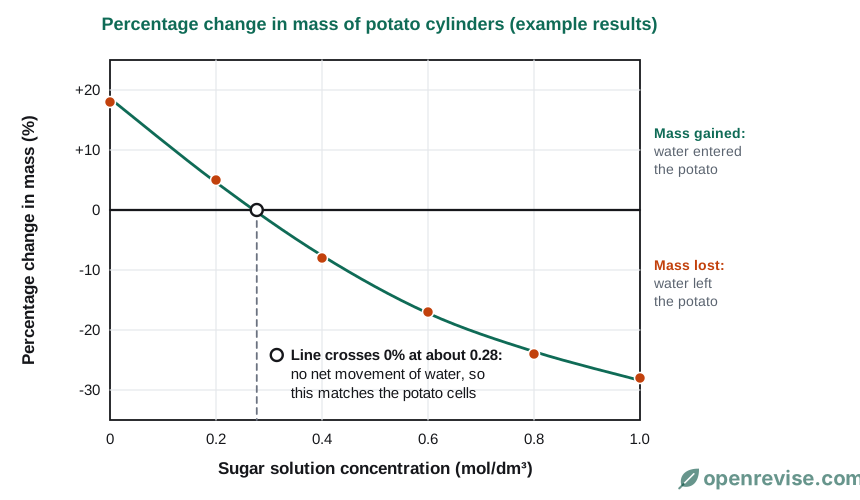
(a) Use the graph to estimate the concentration of the sugar solution that causes no change in mass. (1 mark)
(b) Explain what this tells you about the potato cells. (1 mark)
(c) State the percentage change in mass in the 0.8 mol/dm3 solution. (1 mark)
Mark scheme
(a) 0.28 (mol/dm3) (1) (allow 0.25 to 0.30)
(b) the solution has the same concentration as the cytoplasm / cell sap, so there is no net movement of water (1)
(c) −24 (%) (1) (allow −23 to −25)
Model answer
(a) About 0.28 mol/dm3.
(b) At this concentration the solution has the same concentration as the cells, so there is no net movement of water in or out.
(c) The mass decreased by about 24%, so the change is −24%.
A potato cylinder is placed in distilled water. Its mass increases.
Explain why.
Mark scheme
- water enters the cylinder by osmosis (1)
- because the water is more dilute / has a higher water concentration than the cell contents (1)
- through the partially permeable cell membranes (1)
Model answer
Distilled water is more dilute than the contents of the potato cells, so water moves into the cells by osmosis, through their partially permeable membranes. This increases the mass.
Suggest two improvements to the investigation that would make the results more reliable or more precise. Explain how each improvement would help.
Mark scheme
Any two improvements, each with an explanation:
- repeat each concentration with more cylinders and calculate a mean (1) to reduce the effect of anomalies / random errors (1)
- use more concentrations close to where the line crosses zero (1) to give a more precise estimate of the concentration of the cell sap (1)
- use a balance that reads to 0.01 g (1) to reduce the percentage error in the mass (1)
Model answer
Repeat each concentration with several cylinders and calculate a mean, which reduces the effect of anomalous results. Also test more concentrations close to where the line crosses zero, which gives a more precise estimate of the concentration of the potato cells.
Found a mistake?