1.17 Required practical: osmosis in plant tissue
How to investigate the effect of different concentrations of sugar solution on the mass of potato cylinders: method, variables, percentage change in mass, plotting the graph and finding the concentration of the cell sap.
AQA
Edexcel
OCR
3 min read
The practical
Key terms
- Independent variable: the variable you change.
- Dependent variable: the variable you measure.
- Control variables: variables kept the same so that the test is fair.
- Anomaly: a result that does not fit the pattern of the other results.
- Percentage change in mass: the change in mass divided by the starting mass, multiplied by 100.
Aim: to investigate the effect of a range of concentrations of salt or sugar solutions on the mass of plant tissue, using potato.
Method
- Make sugar solutions of different concentrations, for example 0 (distilled water), 0.2, 0.4, 0.6, 0.8 and 1.0 mol/dm3. Use 20 cm3 of each in a labelled test tube.
- Use a cork borer to cut cylinders from a potato. Trim them all to the same length, for example 3 cm, and remove the skin.
- Blot each cylinder dry with a paper towel. Measure its mass on a balance and record it.
- Put one cylinder in each test tube.
- Leave them for about 30 minutes.
- Take each cylinder out, blot it dry and measure its mass again.
- Work out the percentage change in mass for each cylinder.

| Concentration (mol/dm3) | Stock solution (cm3) | Distilled water (cm3) |
|---|---|---|
| 0 | 0 | 20 |
| 0.2 | 4 | 16 |
| 0.4 | 8 | 12 |
| 0.6 | 12 | 8 |
| 0.8 | 16 | 4 |
| 1.0 | 20 | 0 |
Variables
- Independent variable: the concentration of the sugar solution.
- Dependent variable: the percentage change in mass of the potato cylinder.
- Control variables: the length and diameter of the cylinders, the type and age of the potato, the volume of solution, the temperature, and the time in the solution.
Why do it this way?
- Blotting dry removes water on the surface, which would add to the mass and give a false reading.
- Percentage change is used because the cylinders do not start with exactly the same mass. A percentage lets you compare them fairly.
- The cylinders are cut to the same length and diameter so that they have the same surface area for osmosis.
- The potato skin is removed because it affects how fast water moves in and out.
Results
Plot a graph of percentage change in mass (up the side) against concentration of the solution (along the bottom), and draw a smooth line or line of best fit.
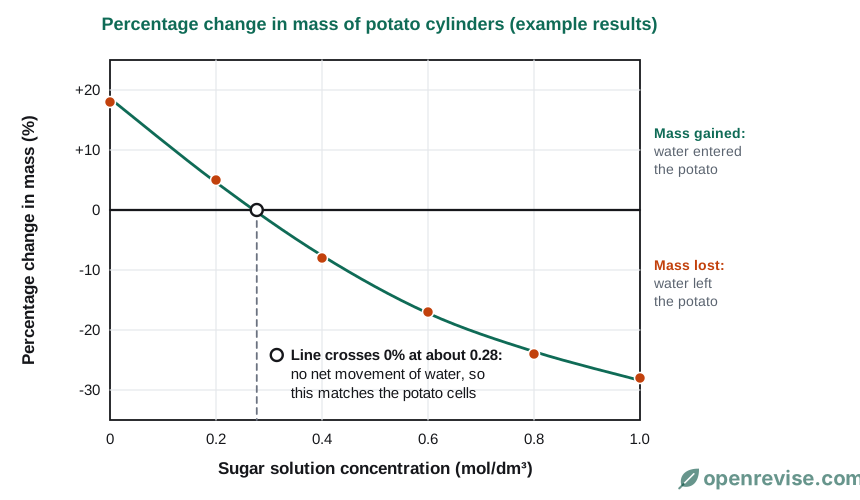
- Where the line is above zero, the potato gained water: the solution was more dilute than the cells.
- Where the line is below zero, the potato lost water: the solution was more concentrated than the cells.
- Where the line crosses zero, there was no net movement of water, so the solution has the same concentration as the potato cells. In this example it is about 0.28 mol/dm3.
Evaluating
- Repeat each concentration with several cylinders and calculate a mean. This makes the results more reliable and helps you to spot anomalies.
- Test more concentrations close to where the line crosses zero, for a more precise estimate of the cell concentration.
- A balance that reads to 0.01 g gives smaller percentage errors than one that reads to 0.1 g.
- Cut potato carefully on a tile, cutting away from your fingers. Wash your hands at the end.
Test yourself on this lesson
7 exam questions · 19 marks · with mark schemes and model answers
Found a mistake?