7.2 Abiotic and biotic factors
The non-living (abiotic) and living (biotic) factors that affect communities, with examples of how a change in each can change the size and distribution of populations.
AQA
Edexcel
OCR
1 min read
Two kinds of factor
Key terms
- Abiotic factor: a non-living factor that affects a community.
- Biotic factor: a living factor that affects a community.
- Distribution: where organisms are found in an area.
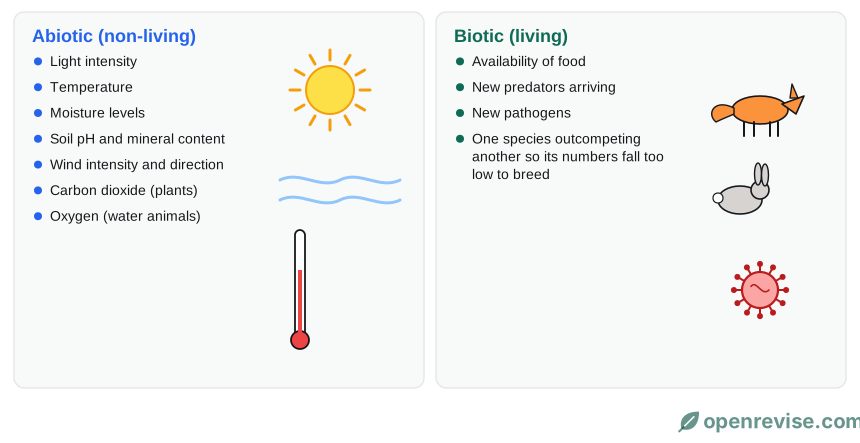
Abiotic factors
- Light intensity: plants need light for photosynthesis, so fewer plants grow under dense trees.
- Temperature: affects enzymes and so growth and activity.
- Moisture levels: plants and animals need water.
- Soil pH and mineral content: some plants only grow in acidic or alkaline soils, and all need mineral ions such as nitrate.
- Wind intensity and direction: affects transpiration and where seeds land.
- Carbon dioxide levels for plants (photosynthesis).
- Oxygen levels for aquatic animals: some invertebrates only survive in water with a lot of dissolved oxygen.
Biotic factors
- Availability of food.
- New predators arriving.
- New pathogens, to which a species has no resistance.
- Competition: one species may outcompete another so its numbers are no longer high enough to breed successfully.
How factors change populations
A change in one factor can change the size of a population, and that affects others through interdependence. For example, a drought (abiotic) reduces grass, so rabbit numbers fall, so fox numbers fall. A new disease (biotic) can wipe out a species, such as ash dieback killing ash trees.
Test yourself on this lesson
5 exam questions · 10 marks · with mark schemes and model answers
Found a mistake?