7.1 Communities and interdependence
The levels of organisation in an ecosystem (individual, population, community, ecosystem), what organisms compete for, interdependence and stable communities, and (Edexcel and OCR) parasitism and mutualism.
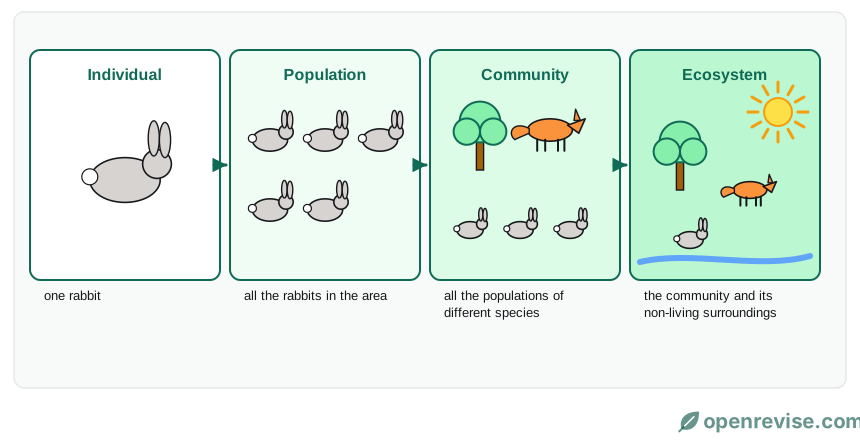
Levels of organisation
Key terms
- Population: all the organisms of one species living in a habitat.
- Community: the populations of different species living in a habitat.
- Ecosystem: the interaction of a community of living organisms (biotic) with the non-living (abiotic) parts of their environment.
- Interdependence: the way species in a community depend on each other.
- Habitat: the place where an organism lives.
Competition
To survive and reproduce, organisms need a supply of materials from their surroundings and from the other living things there. They compete for them.
- Plants compete for light, space, water and mineral ions from the soil.
- Animals compete for food, mates and territory.
Interdependence
Within a community, each species depends on other species for food, shelter, pollination, seed dispersal and so on. If one species is removed, it can affect the whole community: for example, if a disease killed the rabbits, the foxes that eat them would go hungry, but the grass would grow more.
A stable community is one where all the species and environmental factors are in balance, so population sizes stay roughly constant. Tropical rainforests, oak woodlands and coral reefs are examples.
Parasitism and mutualism (Edexcel and OCR)
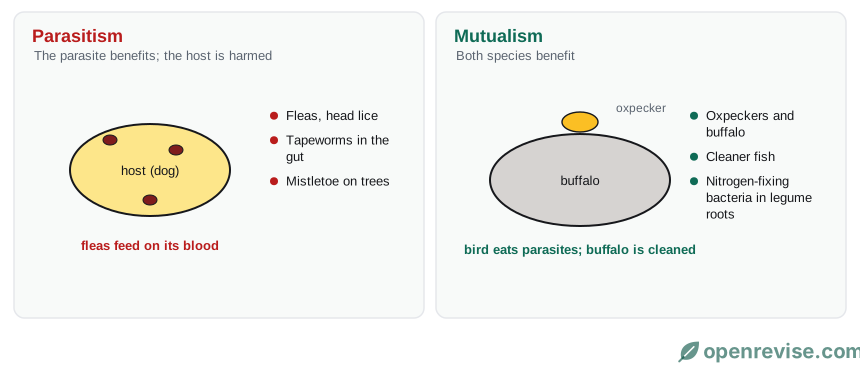
- Parasitism: a parasite lives on or in a host and takes what it needs, harming the host. Examples: fleas, head lice, tapeworms, mistletoe.
- Mutualism: both species benefit. Examples: oxpeckers eat ticks off buffalo; cleaner fish eat parasites off larger fish; nitrogen-fixing bacteria in the root nodules of legumes get sugars from the plant and give it nitrogen compounds.
Test yourself on this lesson
6 exam questions · 12 marks · with mark schemes and model answers
Found a mistake?