7.4 Food chains and predator-prey cycles
How food chains show feeding relationships from producers to primary, secondary and tertiary consumers, why producers are the source of all biomass, and why predator and prey populations rise and fall in linked cycles.
Food chains
Key terms
- Producer: an organism that makes its own food by photosynthesis, such as a green plant or alga.
- Consumer: an organism that eats other organisms.
- Predator: a consumer that kills and eats other animals.
- Prey: an animal that is eaten by a predator.
- Trophic level: the position of an organism in a food chain.
Feeding relationships within a community can be shown by a food chain. All food chains begin with a producer, which makes glucose by photosynthesis. Producers are the source of all the biomass in a community.
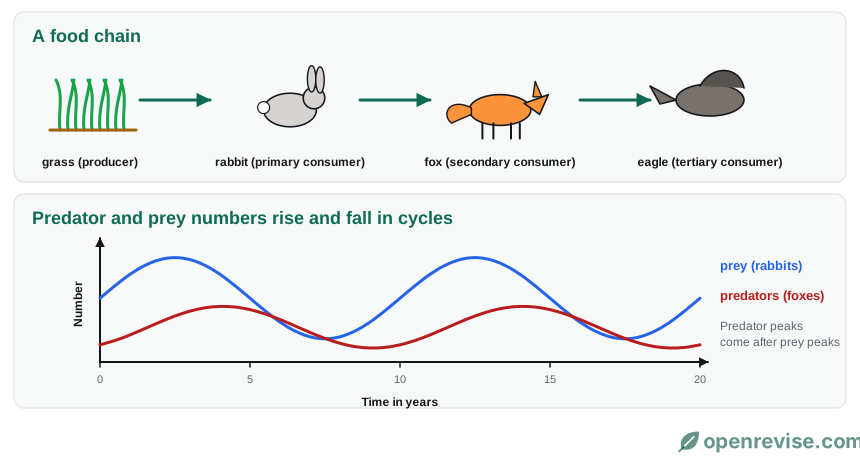
- Primary consumers eat producers.
- Secondary consumers eat primary consumers.
- Tertiary consumers eat secondary consumers.
The arrows in a food chain show the direction that biomass and energy are transferred: from the organism eaten to the one that eats it.
Predator-prey cycles
In a stable community, the numbers of predators and prey rise and fall in cycles:
- When there is plenty of prey, predators have lots of food, so more predators survive and breed, and their numbers rise.
- More predators eat more prey, so the prey numbers fall.
- With less food, fewer predators survive, so their numbers fall.
- With fewer predators, more prey survive and breed, so prey numbers rise again.
The predator peaks come a little after the prey peaks, because it takes time for the predators to breed in response to more food.
Test yourself on this lesson
5 exam questions · 10 marks · with mark schemes and model answers
Found a mistake?