7.5 Required practical: sampling with quadrats and transects
The required practical on sampling: using random quadrats to estimate a population, belt transects to see how distribution changes with an abiotic factor, calculating mean, median and mode, and (OCR) capture-recapture, pooters, sweep nets and pitfall traps.
The aim
To measure the population size of a common species in a habitat, and to see how the distribution of a species changes with an abiotic factor. This is AQA required practical 9, Edexcel core practical 9.5 and part of OCR PAG B3.
Key terms
- Quadrat: a square frame of known area (often 0.25 m2 or 1 m2) used to sample plants or slow-moving animals.
- Transect: a line across a habitat, along which samples are taken.
- Random sampling: placing quadrats so that every part of the area has an equal chance of being sampled, to avoid bias.
Estimating a population with random quadrats
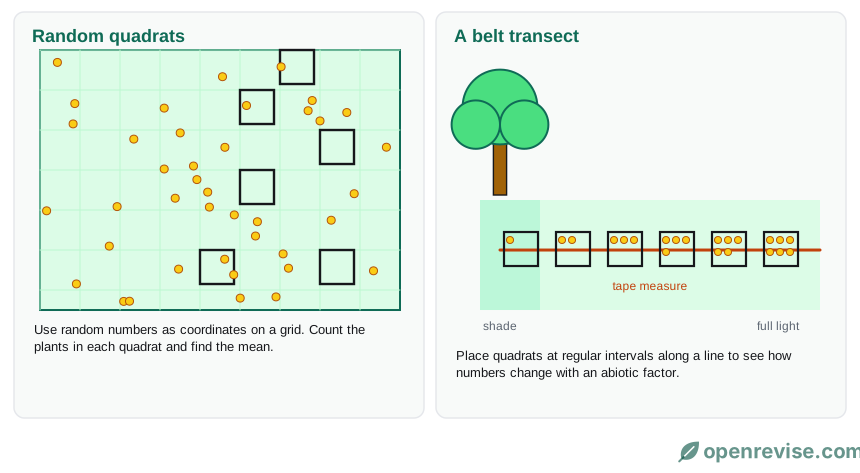
- Lay two tape measures at right angles along two edges of the area, to make a grid.
- Use a random number generator to pick coordinates, and place a quadrat there.
- Count the number of the chosen plant (for example daisies) in the quadrat.
- Repeat for at least 10 quadrats and work out the mean number per quadrat.
- Estimate the total population:
Example: a mean of 6 daisies per 0.25 m2 quadrat in a 200 m2 field: 6 × (200 ÷ 0.25) = 6 × 800 = 4800 daisies.
You may also need the median (middle value) and mode (most common value) of the counts. Where plants are hard to count, record percentage cover instead.
Belt transects
To see how a species changes across a habitat, for example from the shade of a tree into an open field:
- Lay a tape measure along a line from one side to the other.
- Place a quadrat at regular intervals (for example every 2 m) along the line.
- Count the organisms and measure an abiotic factor at each point, such as light intensity with a light meter, soil moisture or pH.
- Look for a correlation between the abiotic factor and the number of organisms.
Sampling animals (OCR)
- Pooters for small insects, sweep nets in long grass, pitfall traps for ground-crawling insects and kick sampling in streams.
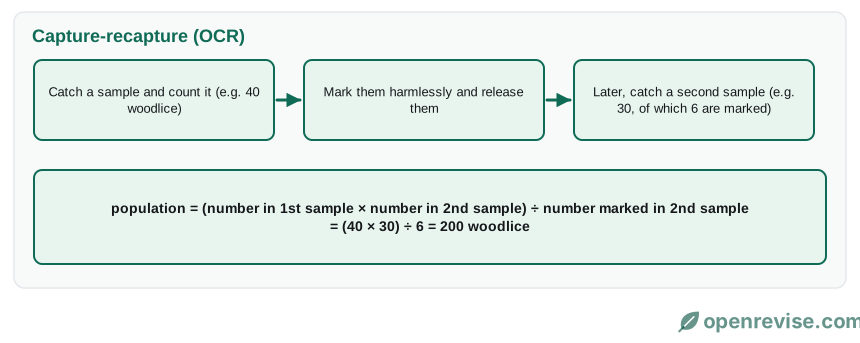
- Capture-recapture estimates the size of a population of animals:
Test yourself on this lesson
6 exam questions · 14 marks · with mark schemes and model answers
Found a mistake?