7.18 Food security and farming
What food security is and what threatens it, how intensive farming increases the efficiency of food production and the ethical concerns, sustainable fisheries with quotas and net sizes, and the use of fertilisers, biological control and hydroponics.
Separate only
AQA
Edexcel
OCR
2 min read
Food security
Key terms
- Food security: having enough food to feed a population.
- Intensive farming: farming that uses methods such as keeping animals indoors and controlling conditions to produce more food from less land.
- Biological control: using a living organism, such as a predator, to control a pest.
- Hydroponics: growing plants without soil, with their roots in a solution of mineral ions.
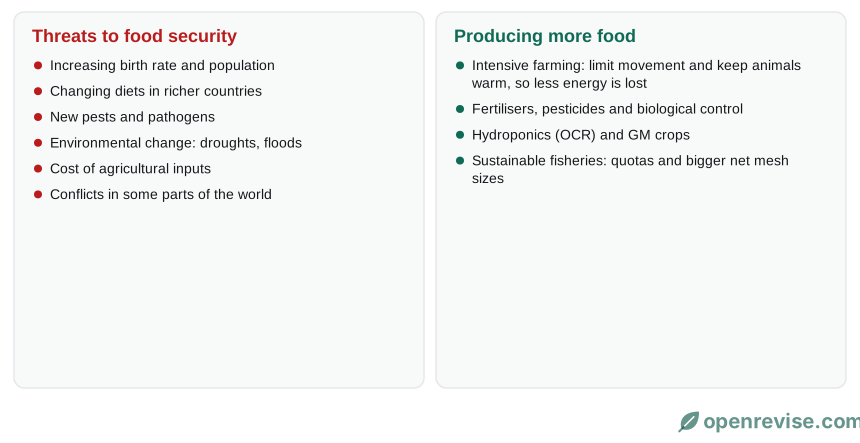
Threats
Biological factors that threaten food security include:
- the increasing birth rate, which has threatened food security in some countries
- changing diets in developed countries, which means scarce food resources are transported around the world
- new pests and pathogens that affect farming
- environmental changes that affect food production, such as widespread famine when rains fail
- the cost of agricultural inputs, such as fertilisers and machinery
- conflicts in some parts of the world, which affect the availability of water or food.
Making food production more efficient
- Intensive farming of animals: limiting their movement and keeping them in temperature-controlled surroundings means less energy is used in movement and keeping warm, so more biomass is gained. Some people object because of the animals' welfare, and the spread of disease in crowded conditions.
- Fertilisers add mineral ions so crops grow more; pesticides kill pests, but may harm other species.
- Biological control uses a natural predator or parasite of the pest (for example, ladybirds to eat aphids). It avoids chemicals, but the control organism might become a pest itself.
- Hydroponics (OCR) controls the mineral ions exactly and avoids soil pests, but costs more.
- Genetically modified crops with higher yields or pest resistance.
Sustainable fisheries
Fish stocks in the oceans are declining. It is important to maintain them at a level where breeding continues, or some species may disappear. Control methods include:
- net size: bigger mesh lets young fish escape so they can grow and breed
- fishing quotas: limits on the number and size of fish that can be caught.
Test yourself on this lesson
5 exam questions · 11 marks · with mark schemes and model answers
Found a mistake?