7.16 Trophic levels and pyramids of biomass
Trophic levels from producers to apex predators, the role of decomposers, and how to draw and interpret pyramids of biomass, including why they are almost always pyramid shaped.
Separate only
AQA
Edexcel
OCR
1 min read
Trophic levels
Key terms
- Trophic level: the feeding level of an organism in a food chain.
- Apex predator: a carnivore with no predators, at the top of a food chain.
- Biomass: the mass of living material.
- Pyramid of biomass: a diagram showing the relative amount of biomass at each trophic level.
Trophic levels are numbered according to the position of the organism in a food chain:
- Level 1: producers, such as plants and algae, which make their own food by photosynthesis.
- Level 2: primary consumers, herbivores that eat plants.
- Level 3: secondary consumers, carnivores that eat herbivores.
- Level 4: tertiary consumers, carnivores that eat other carnivores. Apex predators are carnivores with no predators.
Decomposers (bacteria and fungi) break down dead plant and animal matter by secreting enzymes into the environment. Small soluble molecules then diffuse into the microorganisms.
Pyramids of biomass
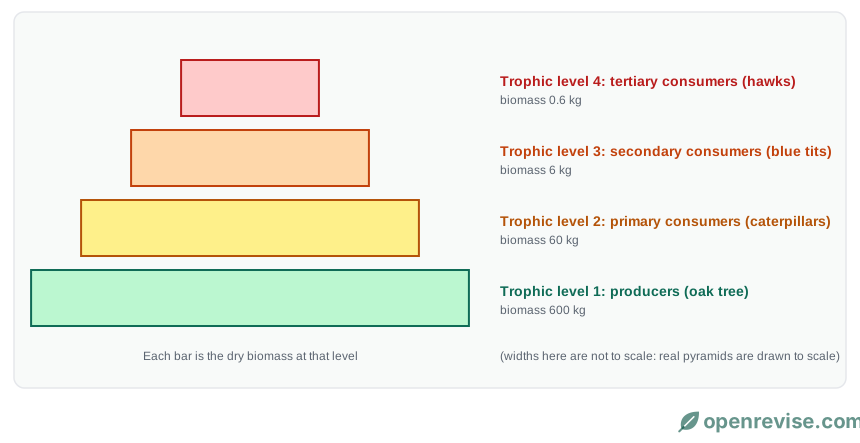
A pyramid of biomass shows the dry biomass at each trophic level. Each bar is drawn to scale: its width shows the biomass.
- The producers are always at the bottom.
- The biomass at each level is less than the level below, so the diagram is a pyramid shape.
- A pyramid of numbers can be an odd shape (one oak tree feeds thousands of caterpillars), but a pyramid of biomass is almost always a true pyramid.
Drawing one
- Use a scale, such as 1 cm = 10 kg.
- Draw the producers as a bar at the bottom, then each level above, centred.
- Label each bar with the trophic level or organism.
Test yourself on this lesson
5 exam questions · 9 marks · with mark schemes and model answers
Found a mistake?