7.15 Fish farming, invasive species and indicator species
Edexcel: the positive and negative effects of fish farming and of introducing non-indigenous species on biodiversity, eutrophication, and (Biology only) indicator species that show water and air pollution, such as stonefly nymphs, bloodworms and lichens.
Humans and biodiversity (Edexcel)
Key terms
- Fish farming: raising fish in enclosures for food.
- Non-indigenous species: a species introduced into an area where it does not naturally live.
- Indicator species: a species whose presence or absence shows the level of pollution.
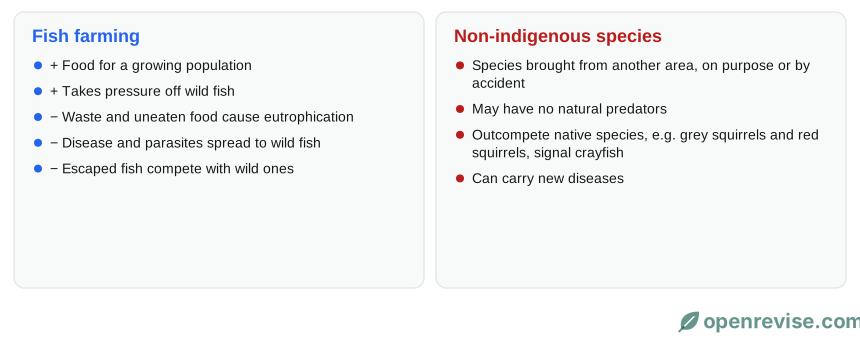
Fish farming
Fish farms produce food for the growing human population and take some pressure off wild fish stocks. But:
- fish waste and uneaten food enter the water and cause eutrophication
- diseases and parasites spread easily in crowded pens and pass to wild fish
- escaped farmed fish can compete or breed with wild fish
- wild fish are often caught to feed the farmed fish.
Non-indigenous species
When a species is introduced to a new area, deliberately or by accident, it may have no natural predators there. It can outcompete native species for food and space, or bring new diseases. Examples: grey squirrels from North America have replaced red squirrels in much of the UK and carry squirrel pox; signal crayfish have spread a disease that kills native crayfish.
Eutrophication
Fertilisers and sewage in water cause algae to grow fast, blocking light. Plants below die, bacteria decompose them and use up the oxygen, and fish and other animals die. (See the lesson on biodiversity and pollution.)
Indicator species (Biology only)
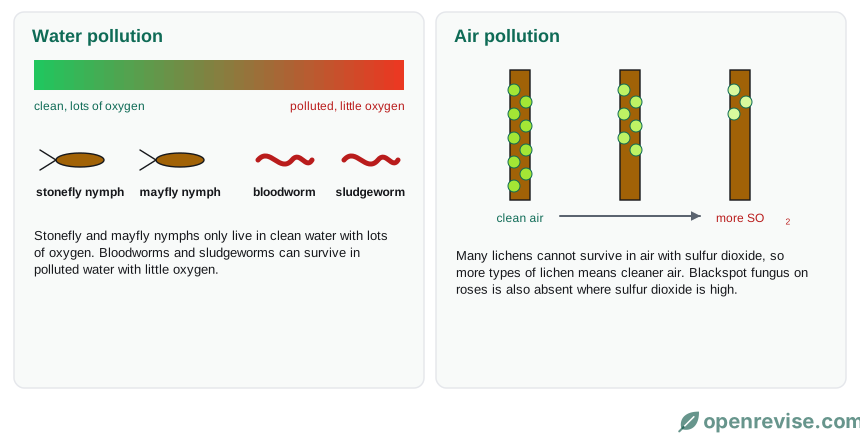
- Water: stonefly and mayfly nymphs need water with a lot of dissolved oxygen, so they show the water is clean. Bloodworms and sludgeworms can survive in water with very little oxygen, so finding only these shows the water is polluted (for example by sewage).
- Air: many lichens cannot survive where the air contains sulfur dioxide, so a variety of lichens shows clean air. Blackspot fungus on roses is killed by sulfur dioxide, so it is found where the air is clean.
Indicator species are cheap and show the effect of pollution over a long time, but they do not give exact pollution levels; instruments do that.
Test yourself on this lesson
5 exam questions · 10 marks · with mark schemes and model answers
Found a mistake?