5.12 Controlling blood glucose
6 exam questions worth 19 marks. Write your answer, open the mark scheme, then give yourself the marks you earned. Your answers are saved on this device.
0 / 19
Which organ monitors and controls the concentration of glucose in the blood?
Choose one answer.
Correct Not quite: the answer is Pancreas
Mark scheme
B (pancreas)
Model answer
B: the pancreas.
Explain how the body returns blood glucose concentration to normal after a meal rich in carbohydrate.
Mark scheme
- (rise in) blood glucose detected by the pancreas (1)
- pancreas secretes / releases insulin (into the blood) (1)
- insulin causes glucose to move (from the blood) into cells (1)
- (in liver / muscle cells) glucose is converted to glycogen (1)
- glycogen is stored (in the liver / muscles) (1)
Max 4
Model answer
The pancreas detects the rise in blood glucose and secretes insulin into the blood. Insulin causes glucose to move from the blood into cells, especially liver and muscle cells, where excess glucose is converted into glycogen and stored. So the blood glucose concentration falls back to normal.
Look at the graph of blood glucose and insulin after a meal.
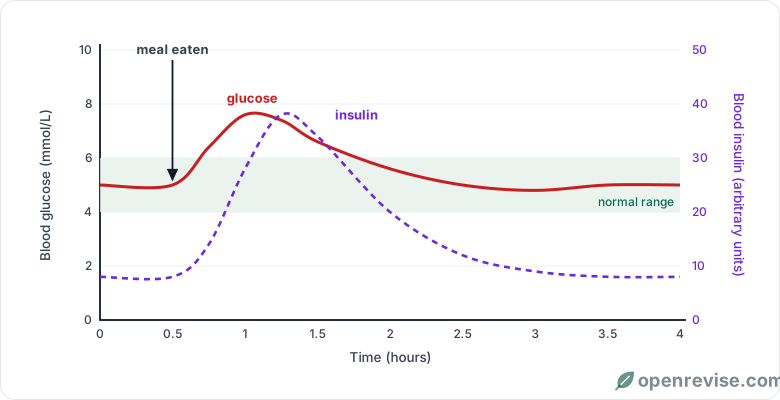
(a) Give the maximum blood glucose concentration. (b) Explain why the insulin level rises after the glucose level starts to rise.
Mark scheme
(a) 7.6 mmol/L (allow 7.5 to 7.7) (1) (b) - the pancreas detects the high glucose (concentration) (1)
- and (then) releases insulin to lower it / it takes time to release insulin (1)
Model answer
(a) About 7.6 mmol/L. (b) The insulin is released in response to the rise in glucose: the pancreas detects the increase and then secretes insulin to bring the level down.
Higher tier. Explain how insulin and glucagon interact to keep blood glucose concentration constant.
Mark scheme
Level 3 (5-6): both hormones explained with their effects and the negative feedback interaction clearly described. Level 2 (3-4): both hormones described with some correct effects, or one explained in full. Level 1 (1-2): basic points, e.g. insulin lowers glucose.
Indicative content:
- pancreas monitors blood glucose
- high glucose: insulin released
- glucose moves into (liver / muscle) cells
- converted to glycogen (stored)
- low glucose: glucagon released
- glycogen converted (back) to glucose in the liver
- glucose released into the blood
- the hormones have opposite effects
- negative feedback: when the level returns to normal, less hormone is released
Model answer
The pancreas monitors the blood glucose concentration. If it rises above normal, the pancreas secretes insulin, which makes glucose move from the blood into liver and muscle cells, where it is converted into glycogen and stored, so the level falls. If blood glucose falls too low, the pancreas secretes glucagon, which makes the liver convert glycogen back into glucose and release it into the blood, so the level rises. The two hormones have opposite effects, and this is negative feedback: each change triggers a response that reverses it, and once the level is back to normal less of the hormone is released.
A runner's blood glucose concentration falls during a long race.
Name the hormone released and describe its effect.
Mark scheme
- glucagon (1)
- (causes) glycogen to be converted into glucose (1)
- (in the liver,) glucose released into the blood (1)
Model answer
Glucagon is released by the pancreas. It makes liver cells convert glycogen into glucose, which is released into the blood, so blood glucose rises.
Explain why it is important that there is always some glucose in the blood.
Mark scheme
- cells need glucose for respiration (1)
- to release energy (for processes such as muscle contraction / for the brain) (1)
Model answer
All cells use glucose for respiration to release the energy they need, so a constant supply must be carried to them in the blood.
Found a mistake?