5.12 Controlling blood glucose
How the pancreas controls blood glucose: insulin moves glucose into liver and muscle cells to be stored as glycogen, and (Higher) glucagon turns glycogen back into glucose.
Why blood glucose must be controlled
Key terms
- Insulin: a hormone made by the pancreas when blood glucose is too high. It causes glucose to move from the blood into cells.
- Glycogen: a storage carbohydrate made from glucose, stored in liver and muscle cells.
- Glucagon: a hormone made by the pancreas when blood glucose is too low. It causes glycogen to be converted into glucose and released into the blood.
Every cell needs glucose for respiration, so there must always be glucose in the blood. But the amount rises after a meal (carbohydrates are digested into glucose) and falls when you exercise or go without food. If it gets too high or too low, cells and organs can be damaged.
Blood glucose concentration is monitored and controlled by the pancreas. The pancreas acts as both the receptor (its cells detect the glucose concentration) and the coordinator, and it uses two hormones.
When blood glucose is too high: insulin
- After a meal, the blood glucose concentration rises.
- Cells in the pancreas detect the rise and secrete the hormone insulin into the blood.
- Insulin causes glucose to move from the blood into cells, especially muscle and liver cells.
- In the liver and muscle cells, excess glucose is converted into glycogen for storage.
- The blood glucose concentration falls back to normal.
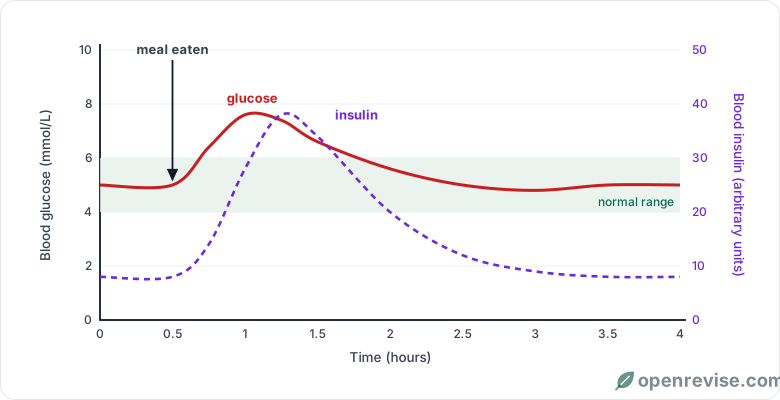
On the graph, the insulin level rises soon after blood glucose rises, and falls again once glucose is back to normal: that is the control system at work.
Higher tier: when blood glucose is too low: glucagon
- During exercise, or a long time without food, blood glucose falls.
- The pancreas detects the fall and secretes a second hormone, glucagon.
- Glucagon causes glycogen in the liver to be converted into glucose.
- The glucose is released into the blood, so blood glucose rises back to normal.
A negative feedback cycle
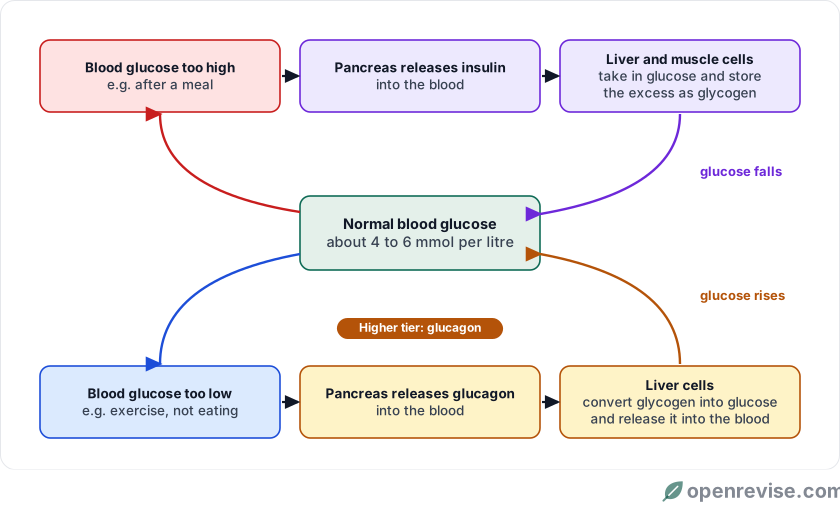
Insulin and glucagon work against each other in a negative feedback cycle. Any rise in blood glucose triggers insulin, which brings it down; any fall triggers glucagon, which brings it up. As soon as the level is back to normal, less of each hormone is released. This keeps blood glucose within narrow limits (roughly 4 to 6 mmol per litre when fasting).
| Feature | Insulin | Glucagon (Higher) |
|---|---|---|
| Made by | Pancreas | Pancreas |
| Released when blood glucose is | Too high | Too low |
| Main targets | Liver and muscle cells | Liver cells |
| Effect | Glucose moves into cells; glucose converted to glycogen | Glycogen converted to glucose; glucose released into the blood |
| Blood glucose | Goes down | Goes up |
Test yourself on this lesson
6 exam questions · 19 marks · with mark schemes and model answers
Found a mistake?