5.13 Diabetes
6 exam questions worth 19 marks. Write your answer, open the mark scheme, then give yourself the marks you earned. Your answers are saved on this device.
0 / 19
Describe the cause of type 1 diabetes and how it is treated.
Mark scheme
- pancreas does not produce (enough) insulin (1)
- (treated with) insulin injections (1)
Model answer
In type 1 diabetes the pancreas fails to produce enough insulin. It is treated with insulin injections.
Compare type 1 and type 2 diabetes.
Mark scheme
- type 1: pancreas does not produce enough insulin; type 2: cells no longer respond to insulin (1)
- type 1 treated with insulin injections; type 2 with diet / exercise (first) (1)
- type 2 linked to obesity / lifestyle; type 1 not (1)
- type 1 usually starts in childhood; type 2 usually in adults (1)
- both: high blood glucose (1)
Max 4
Model answer
Both cause high blood glucose. In type 1, the pancreas does not make enough insulin, whereas in type 2 the pancreas still makes insulin but the body's cells no longer respond to it. Type 1 usually starts in childhood and is treated with insulin injections; type 2 usually develops in adults, is linked to obesity, and is first treated with a carbohydrate-controlled diet and exercise.
A woman has a mass of 82 kg and a height of 1.65 m.
Calculate her BMI using the equation:
Give your answer to 1 decimal place, and use the table of BMI ranges to say which category she is in.
Mark scheme
- 82 ÷ 1.65² = 82 ÷ 2.7225 (1)
- = 30.1 (1)
- obese (1)
- allow ecf for category
Model answer
BMI = 82 ÷ 1.65² = 82 ÷ 2.7225 = 30.1. This is in the obese range (30 to 39.9).
Look at the graph of blood glucose after a glucose drink.
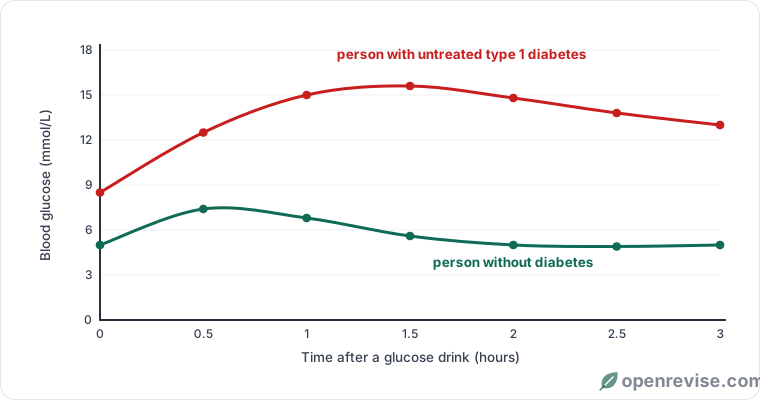
Describe and explain the differences between the two people's results.
Mark scheme
- person with diabetes starts with a higher glucose concentration (8.5 vs 5.0 mmol/L) (1)
- rises higher / to over 15 mmol/L vs 7.4 mmol/L (1)
- stays high / does not return to normal, whereas the other returns to normal within about 2 hours (1)
- because the person with type 1 diabetes produces little / no insulin (1)
- so glucose is not moved into cells / not converted to glycogen (1)
Max 4; data quoted with units for full marks
Model answer
The person with diabetes starts higher (8.5 mmol/L compared with 5.0 mmol/L), rises much higher (about 15.6 compared with 7.4 mmol/L) and is still high after 3 hours, while the other person is back to normal after about 2 hours. This is because the person with type 1 diabetes produces too little insulin, so glucose is not moved from the blood into cells and stored as glycogen.
Explain why insulin is given by injection and not as a tablet.
Mark scheme
- insulin is a protein (1)
- it would be digested (by proteases) in the stomach / gut (before it reached the blood) (1)
Model answer
Insulin is a protein, so if it were swallowed it would be digested by protease enzymes in the gut before it could reach the blood.
Scientists found that people with a high waist:hip ratio are more likely to develop type 2 diabetes.
A politician suggests a tax on sugary drinks to reduce the number of people with type 2 diabetes. Evaluate this suggestion.
Mark scheme
- for: sugary drinks are high in energy / can lead to obesity (1)
- for: obesity is a risk factor for type 2 diabetes, so reducing it could reduce cases / save healthcare costs (1)
- against: correlation does not prove sugar causes diabetes / other factors (exercise, genetics, age) (1)
- against: people may buy other unhealthy foods / unfair on people on low incomes / personal freedom (1)
- a justified conclusion (1)
Max 4
Model answer
Sugary drinks contain a lot of energy, so cutting them could reduce obesity, the main risk factor for type 2 diabetes, and save money spent on treatment. However, the evidence is a correlation, and other factors such as lack of exercise, age and genes also matter; people might switch to other unhealthy foods, and the tax hits people on low incomes hardest. It could help as one part of a wider plan, including education and exercise, but it would not prevent type 2 diabetes on its own.
Found a mistake?