5.13 Diabetes
Type 1 and type 2 diabetes compared: causes, treatments, reading glucose graphs, and the link between obesity, BMI, waist:hip ratio and type 2 diabetes.
What is diabetes?
Key terms
- Type 1 diabetes: a disorder in which the pancreas fails to produce enough insulin, so blood glucose rises uncontrollably.
- Type 2 diabetes: a disorder in which the body's cells no longer respond properly to insulin.
- Risk factor: something that increases the chance of developing a disease.
- BMI (body mass index): a measure of body mass relative to height, used to judge whether someone is a healthy weight.
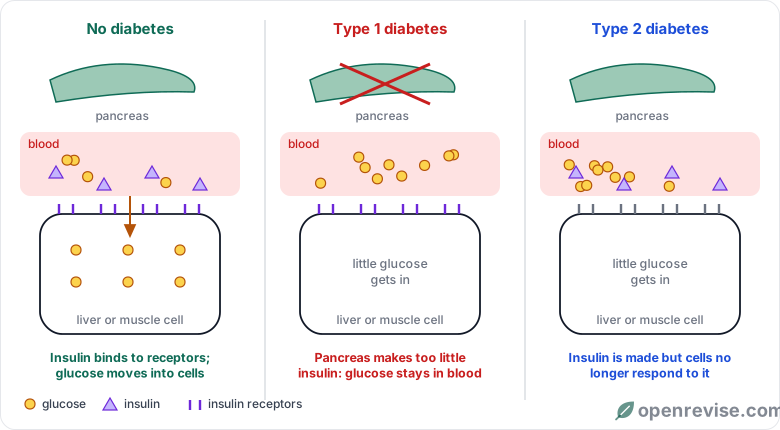
In diabetes, the body cannot control its blood glucose concentration properly. Glucose stays in the blood instead of moving into cells, so blood glucose can become dangerously high. Common signs include feeling very thirsty, passing a lot of urine (which contains glucose), tiredness and weight loss.
Type 1 diabetes
- Cause: the pancreas fails to produce enough insulin. It usually starts in childhood or as a young adult. It happens when the immune system destroys the insulin-producing cells of the pancreas.
- Effect: uncontrolled high blood glucose levels.
- Treatment: insulin injections (or an insulin pump), usually at mealtimes, matched to the amount of carbohydrate eaten. People also monitor their blood glucose, eat a balanced diet and exercise. Insulin cannot be swallowed as a tablet, because it is a protein that would be digested in the gut.
- Pancreas transplants and transplants of pancreas cells have been tried, but there are not enough donors and the patient must take drugs to stop rejection.
Type 2 diabetes
- Cause: the body's cells no longer respond to insulin produced by the pancreas (or the pancreas does not make enough). It usually develops in adults.
- Main risk factor: obesity. Other risk factors include lack of exercise, increasing age and a family history.
- Treatment: a carbohydrate-controlled diet and an exercise regime, which help cells respond to insulin and reduce body mass. If that is not enough, medicines are used, and sometimes insulin injections.
| Feature | Type 1 | Type 2 |
|---|---|---|
| Cause | Pancreas does not produce enough insulin | Body cells no longer respond to insulin |
| Usual age of onset | Childhood or young adult | Usually adults (now more young people) |
| Main risk factor | Not linked to lifestyle | Obesity, lack of exercise |
| Treatment | Insulin injections, plus diet and exercise | Carbohydrate-controlled diet and exercise; then medicines |
| How common in the UK | About 1 in 10 people with diabetes | About 9 in 10 people with diabetes |
Reading diabetes graphs
A glucose tolerance test measures blood glucose after drinking a glucose solution.
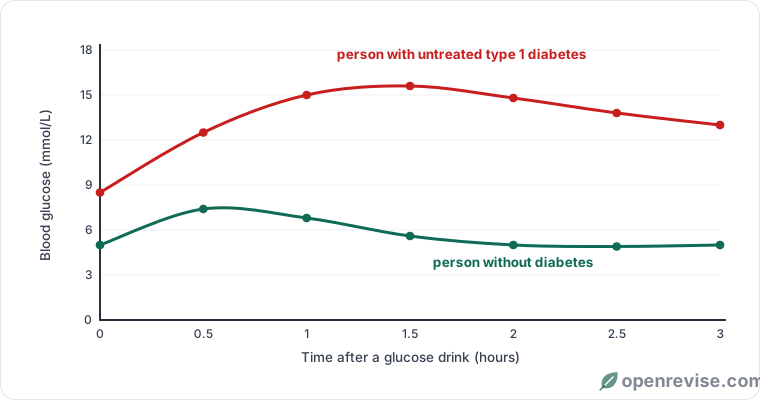
- Without diabetes, blood glucose rises a little, then insulin brings it back to normal within about 2 hours.
- With untreated type 1 diabetes, blood glucose starts higher, rises much higher, and stays high, because there is little insulin to bring it down.
When you describe a graph, quote values with units, for example: "it rose from 8.5 to 15.6 mmol/L in 1.5 hours and was still 13.0 mmol/L after 3 hours".
Obesity, BMI and type 2 diabetes
There is a strong correlation between obesity and type 2 diabetes: the higher a person's body mass, the higher their risk. Doctors judge whether someone is obese using BMI:
| BMI | Category |
|---|---|
| Below 18.5 | Underweight |
| 18.5 to 24.9 | Healthy weight |
| 25 to 29.9 | Overweight |
| 30 to 39.9 | Obese |
| 40 or more | Severely obese |
Worked example. A man has a mass of 95 kg and a height of 1.80 m. BMI = 95 ÷ 1.80² = 95 ÷ 3.24 = 29.3, so he is overweight.
BMI does not tell you where fat is stored, and a very muscular person can have a high BMI without being fat. Fat stored around the waist is most strongly linked to type 2 diabetes, so doctors also use the waist:hip ratio:
A ratio above about 0.90 in men or 0.85 in women suggests too much fat around the abdomen and a higher risk. Worked example: waist 96 cm, hips 100 cm, ratio = 96 ÷ 100 = 0.96.
Test yourself on this lesson
6 exam questions · 19 marks · with mark schemes and model answers
Found a mistake?