5.10 The endocrine system
6 exam questions worth 14 marks. Write your answer, open the mark scheme, then give yourself the marks you earned. Your answers are saved on this device.
0 / 14
The diagram shows the positions of some endocrine glands.
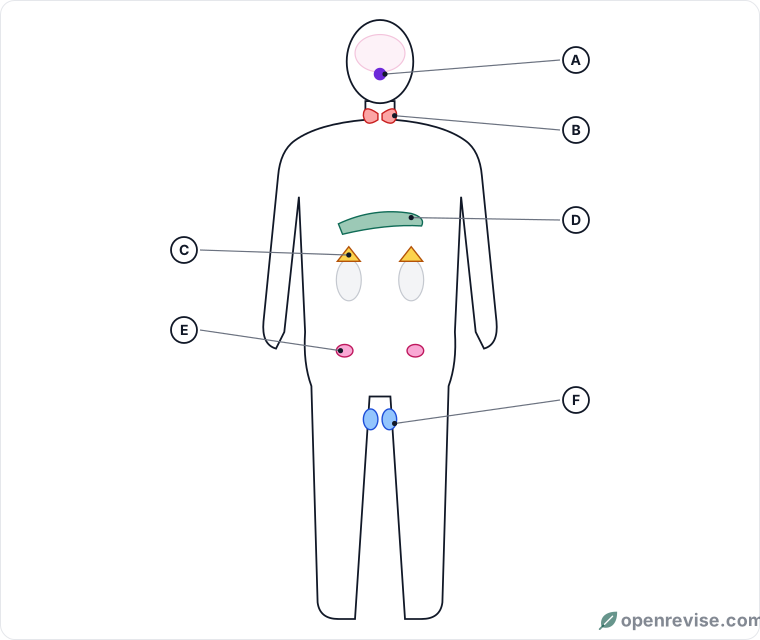
Name glands A, B and D.
Mark scheme
- A: pituitary (gland) (1)
- B: thyroid (gland) (1)
- D: pancreas (1)
Model answer
A is the pituitary gland, B is the thyroid gland and D is the pancreas.
Which gland produces adrenaline?
Choose one answer.
Correct Not quite: the answer is Adrenal gland
Mark scheme
C (adrenal gland)
Model answer
C: the adrenal gland.
Describe how a hormone travels from an endocrine gland to its target organ.
Mark scheme
- (hormone) secreted / released (directly) into the blood(stream) (1)
- carried in the blood (plasma) to the target organ (1)
Model answer
The gland secretes the hormone directly into the bloodstream, and the blood carries it around the body to the target organ.
The pituitary gland is often called the "master gland".
Explain why.
Mark scheme
- it secretes (several) hormones (1)
- that act on / stimulate other glands to release their hormones (1)
- allow example, e.g. TSH stimulates the thyroid / FSH acts on the ovaries
Model answer
It secretes several hormones that act on other glands, causing them to release their own hormones; for example, TSH makes the thyroid gland release thyroxine.
Compare the way the nervous system and the endocrine system coordinate the body.
Mark scheme
- nervous: electrical impulses; endocrine: chemicals / hormones (1)
- nervous: along neurones; endocrine: in the blood (1)
- nervous is faster (1)
- endocrine effects last longer (1)
- nervous acts on a precise / small area; hormones can act on many / widespread target organs (1)
Max 4; comparisons must give both sides
Model answer
The nervous system uses electrical impulses along neurones, while the endocrine system uses hormones carried in the blood. Nervous responses are much faster but short-lived, whereas hormonal effects are slower but last longer. Nerves act on a precise place, but a hormone can affect many organs wherever its target cells are.
Insulin travels to every part of the body in the blood, but only some cells respond to it.
Explain why.
Mark scheme
- only target cells / some cells have receptors for insulin (1)
- the hormone must bind to the receptors to have an effect (1)
Model answer
Only the cells of the target organs have receptors that insulin can bind to, so only those cells respond.
Found a mistake?