5.10 The endocrine system
How endocrine glands release hormones into the blood to act on target organs, where the main glands are, and how hormonal control compares with the nervous system.
Hormones and glands
Key terms
- Endocrine system: the glands that secrete hormones directly into the bloodstream.
- Hormone: a chemical messenger, secreted by a gland and carried in the blood to a target organ, where it produces an effect.
- Target organ: an organ whose cells have receptors for a particular hormone, so they respond to it.
- Pituitary gland: the "master gland" in the brain; its hormones control other glands.
The endocrine system is the body's second coordination system, working alongside the nervous system. It is made of glands that secrete chemicals called hormones directly into the bloodstream.
- A gland secretes a hormone into the blood.
- The blood carries the hormone all around the body.
- Only cells with the right receptors for that hormone respond. These are the cells of the target organ.
- The hormone produces its effect on the target organ.
Hormones are often large molecules, such as proteins. Compared with the nervous system, their effects are slower but act for longer.
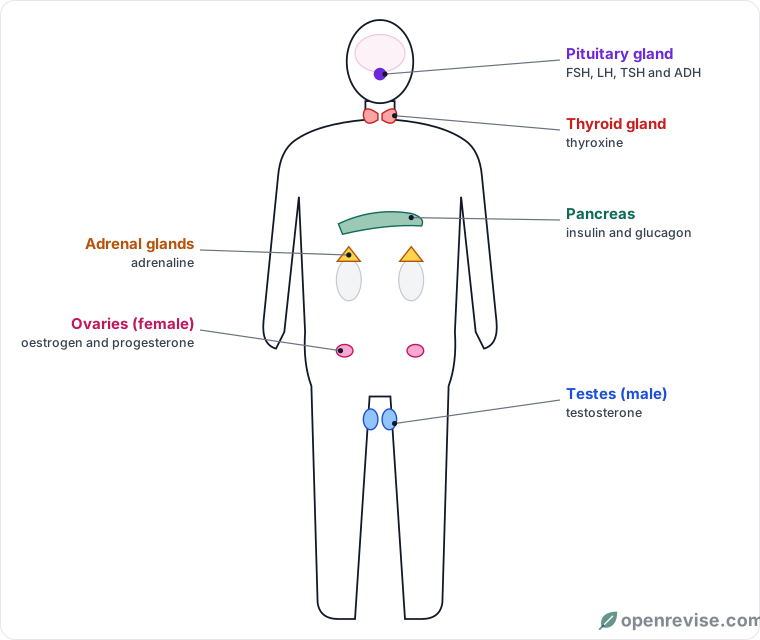
The main glands
| Gland | Where it is | Hormone(s) | Main effect |
|---|---|---|---|
| Pituitary gland | Base of the brain | FSH, LH, TSH, ADH, growth hormone | Controls other glands; ADH controls water balance |
| Thyroid gland | Neck | Thyroxine | Controls the basal metabolic rate, growth and development |
| Adrenal glands | On top of the kidneys | Adrenaline | Prepares the body for "fight or flight" |
| Pancreas | Abdomen, below the stomach | Insulin and glucagon | Control blood glucose concentration |
| Ovaries | Pelvis (females) | Oestrogen and progesterone | Menstrual cycle, female secondary sexual characteristics |
| Testes | Scrotum (males) | Testosterone | Sperm production, male secondary sexual characteristics |
The pituitary: the master gland
The pituitary gland, in the brain, is called the "master gland". It secretes several hormones into the blood in response to body conditions. Many of these act on other glands, telling them to release their own hormones. For example:
- TSH (thyroid stimulating hormone) makes the thyroid release thyroxine.
- FSH and LH act on the ovaries (and testes).
Other pituitary hormones, such as ADH (which acts on the kidneys) and growth hormone, act directly on organs.
Nerves and hormones compared
| Feature | Nervous system | Endocrine system |
|---|---|---|
| Type of message | Electrical impulses (and chemicals at synapses) | Chemicals (hormones) |
| How it travels | Along neurones | In the blood |
| Speed | Very fast | Slower |
| How long the effect lasts | Short | Longer |
| Where it acts | A precise place (one muscle or gland) | Can act on many organs, wherever there are receptors |
| Example | Reflex to pull a hand from heat | Insulin lowering blood glucose |
Test yourself on this lesson
6 exam questions · 14 marks · with mark schemes and model answers
Found a mistake?