5.22 Contraception
6 exam questions worth 17 marks. Write your answer, open the mark scheme, then give yourself the marks you earned. Your answers are saved on this device.
0 / 17
Explain how the combined contraceptive pill prevents pregnancy.
Mark scheme
- contains oestrogen and progesterone (1)
- inhibits FSH (production) (1)
- so no eggs mature / are released (1)
- allow: thickens cervical mucus so sperm cannot reach the egg (1)
Max 3
Model answer
The pill contains oestrogen and progesterone, which inhibit the production of FSH. Without FSH, no eggs mature, so there is no egg to be fertilised.
How does an intrauterine device (IUD) prevent pregnancy?
Choose one answer.
Correct Not quite: the answer is It prevents an embryo implanting in the uterus
Mark scheme
C
Model answer
C: it prevents an embryo implanting in the uterus.
Give one advantage and one disadvantage of using a condom as a contraceptive.
Mark scheme
- advantage: protects against STIs / no hormones / no side effects / easy to obtain (1)
- disadvantage: can split / slip off / less effective than hormonal methods / must be used every time (1)
Model answer
A condom protects against sexually transmitted infections, but it can split, so it is less effective than hormonal methods.
Use the bar chart of contraceptive effectiveness.
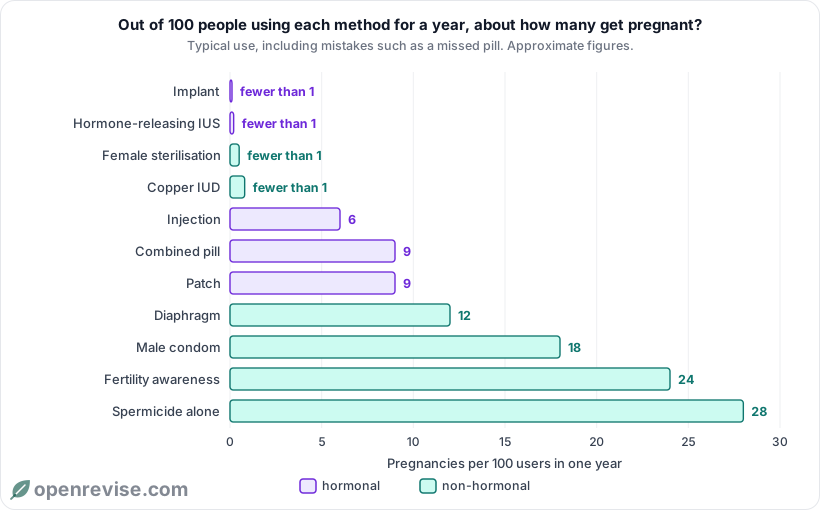
(a) How many more pregnancies per 100 users per year are there with male condoms than with the combined pill? (b) Suggest why the pill is less effective with typical use than with perfect use.
Mark scheme
(a) 18 - 9 = 9 (1) (b) - people forget to take it / miss pills (1)
- so FSH is no longer inhibited and an egg may mature (1)
- allow: vomiting or other medicines stop it being absorbed
Model answer
(a) 18 - 9 = 9 more pregnancies per 100 users. (b) People sometimes forget to take a pill, so FSH is no longer inhibited and an egg can mature and be released.
A couple are deciding between a progesterone implant and condoms.
Evaluate the two methods.
Mark scheme
Level 3 (5-6): a balanced evaluation of both methods using effectiveness, side effects, STI protection and practicality, with a justified conclusion. Level 2 (3-4): advantages and disadvantages of both, or detailed for one, with limited conclusion. Level 1 (1-2): simple points about one method.
Indicative content: Implant: very effective (fewer than 1 in 100 per year); lasts about 3 years; nothing to remember; progesterone stops eggs maturing and being released; side effects such as irregular bleeding; must be fitted by a doctor; no STI protection; reversible when removed Condoms: protect against STIs; no hormones / no side effects; cheap and easy to get; less effective (about 18 in 100 per year with typical use); can split or slip; must be used every time Conclusion: e.g. implant is better at preventing pregnancy, condoms needed for STI protection; could use both
Model answer
The implant releases progesterone, which stops eggs maturing and being released. It is very effective (fewer than 1 pregnancy per 100 users a year) and lasts about 3 years with nothing to remember, but it must be fitted by a doctor, can cause side effects such as irregular bleeding, and gives no protection against STIs. Condoms are a barrier that stops sperm reaching the egg; they have no hormonal side effects, are easy to get and protect against STIs, but with typical use about 18 in 100 users get pregnant each year because they can split or not be used properly. If preventing pregnancy is the main aim, the implant is better; if the couple are not sure of each other's STI status, using condoms as well would be safest.
Explain why decisions about contraception cannot be made by science alone.
Mark scheme
- science can show how effective / safe a method is (1)
- but decisions also depend on personal / religious / ethical / social views (1)
Model answer
Science can tell us how a method works, how effective it is and its side effects, but people's choices also depend on personal, religious and ethical beliefs, which science cannot answer.
Found a mistake?