5.22 Contraception
How hormonal and non-hormonal methods of contraception prevent pregnancy, how effective each one is, and how to evaluate them.
Controlling fertility
Key terms
- Contraception: any method used to prevent pregnancy.
- Hormonal contraception: methods that use hormones to stop eggs maturing or being released, such as the pill, implant, injection and patch.
- Barrier method: a method that physically stops sperm reaching the egg, such as a condom or diaphragm.
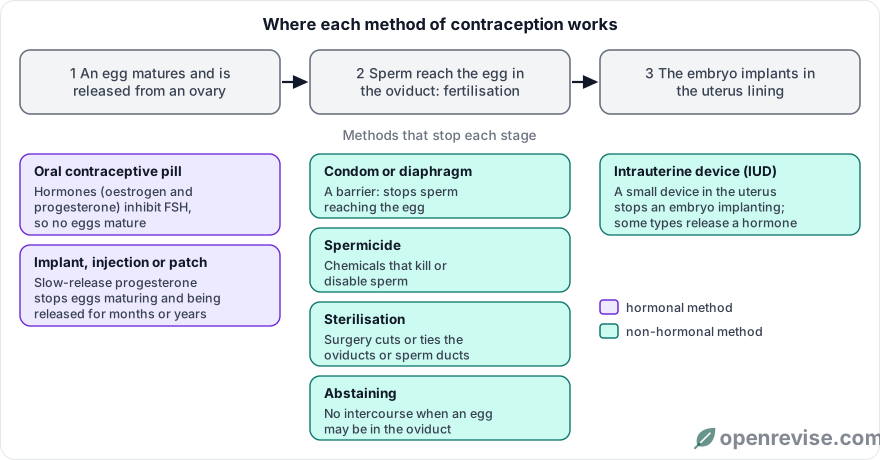
For a woman to become pregnant, three things must happen: an egg must mature and be released, sperm must reach and fertilise the egg in the oviduct, and the embryo must implant in the uterus lining. Every method of contraception stops one of these.
Hormonal methods
- Oral contraceptive pill: the combined pill contains oestrogen and progesterone. These hormones inhibit FSH production, so no eggs mature. They also thicken the mucus at the cervix, making it hard for sperm to get through. It is taken every day.
- Implant, injection or skin patch: these release progesterone slowly. Progesterone inhibits the maturation and release of eggs for months or years (an implant lasts 3 years, an injection about 3 months, a patch 1 week). It also thickens cervical mucus.
- Intrauterine system (IUS): a small T-shaped device in the uterus that releases progesterone.
Hormonal methods work because they copy the high levels of oestrogen and progesterone that naturally stop FSH and LH being released in the second half of the cycle and in pregnancy.
Non-hormonal methods
- Barrier methods: condoms (worn over the penis, or inside the vagina) and diaphragms (a cap over the cervix) stop sperm reaching the egg. Condoms are the only method that also protects against sexually transmitted infections (STIs).
- Spermicidal agents: chemicals that kill or disable sperm. They are not very effective on their own, so are used with a diaphragm.
- Intrauterine device (IUD): a small copper device fitted inside the uterus that prevents an embryo implanting (and is toxic to sperm). It works for 5 to 10 years.
- Abstaining from intercourse when an egg may be in the oviduct (around ovulation), sometimes called fertility awareness or natural family planning.
- Surgical sterilisation: cutting or tying the sperm ducts in a man (vasectomy) or the oviducts in a woman. It is permanent and very hard to reverse.
How effective are they?
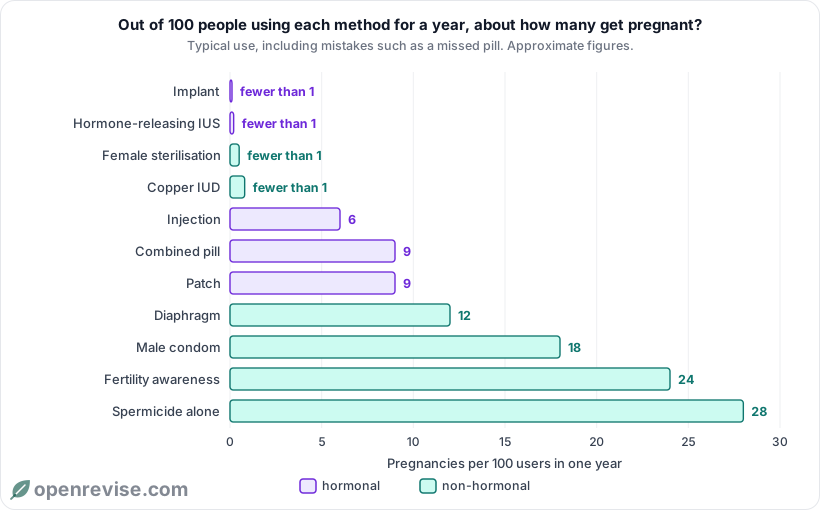
Methods that do not rely on remembering anything (implant, IUD, IUS, sterilisation) are the most effective in real life. The pill is over 99% effective if taken perfectly, but people sometimes forget, so with typical use about 9 in 100 users become pregnant each year.
Evaluating contraception
| Method | Advantages | Disadvantages |
|---|---|---|
| Pill | Very effective if taken correctly; can make periods lighter | Must be taken every day; side effects (mood changes, raised blood pressure, small risk of blood clots); no STI protection |
| Implant or injection | Lasts months or years; nothing to remember | Side effects such as irregular bleeding; a doctor must fit or give it; no STI protection |
| Condom | Protects against STIs; no hormones; easy to get | Can split or slip off; less effective with typical use |
| Diaphragm with spermicide | No hormones; can be put in before sex | Must be fitted correctly; less effective; no STI protection |
| IUD | Works for years; very effective; no hormones (copper type) | Must be fitted by a doctor; periods may be heavier; small risk of infection |
| Sterilisation | Permanent and very effective | Surgery; very hard to reverse |
| Abstaining around ovulation | No side effects; accepted by some religions | Hard to predict ovulation; least effective |
When evaluating, think about effectiveness, side effects, protection against STIs, how easy it is to use, whether it is reversible, and cost. Some people also have religious or ethical objections to certain methods. Science can tell us how a method works and how effective it is, but it cannot decide on its own which method someone should use: that also depends on personal, social and ethical values.
Test yourself on this lesson
6 exam questions · 17 marks · with mark schemes and model answers
Found a mistake?