5.20 Hormones and the menstrual cycle
How testosterone and oestrogen bring about puberty, the stages of the 28-day menstrual cycle, and the jobs of FSH, LH, oestrogen and progesterone.
Puberty
Key terms
- Puberty: the stage of development when reproductive hormones cause the secondary sexual characteristics to develop.
- Oestrogen: the main female reproductive hormone, made in the ovaries.
- Testosterone: the main male reproductive hormone, made in the testes. It stimulates sperm production.
- Ovulation: the release of an egg from an ovary, about every 28 days.
- Menstruation: the loss of the uterus lining (a period), at the start of each cycle.
During puberty, reproductive hormones cause the secondary sexual characteristics to develop, so the body becomes able to reproduce.
| Males (testosterone) | Females (oestrogen) |
|---|---|
| Testes start to produce sperm | Eggs begin to mature and one is released about every 28 days |
| Voice deepens | Breasts develop |
| Hair grows on the face and body | Hips widen |
| Muscles develop | Hair grows in the armpits and pubic area |
| Penis and testes grow | Menstruation (periods) begins |
- Testosterone is the main male reproductive hormone, produced by the testes. It stimulates sperm production.
- Oestrogen is the main female reproductive hormone, produced in the ovaries. At puberty, eggs begin to mature, and one is released approximately every 28 days: this is ovulation.
The menstrual cycle
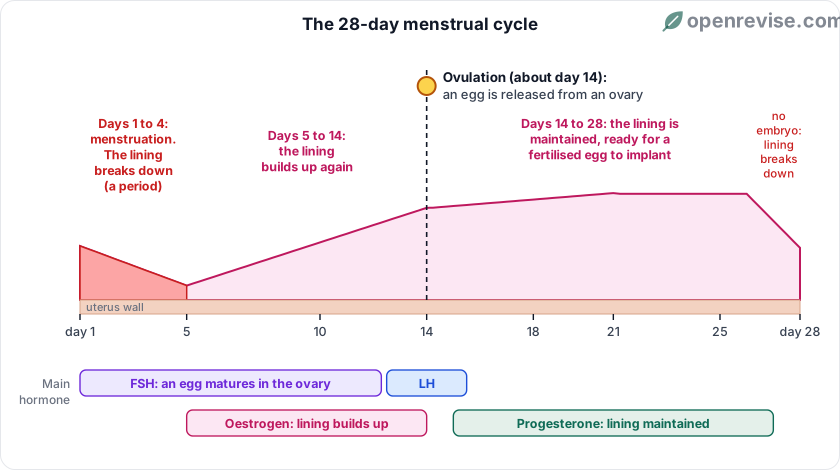
The menstrual cycle prepares the uterus to receive a fertilised egg each month. It lasts about 28 days and has four stages:
- Days 1 to 4: menstruation. The thick lining of the uterus breaks down and leaves the body through the vagina, with some blood. This is a period.
- Days 5 to 14: the lining builds up. The uterus lining thickens again, becoming a spongy layer full of blood vessels. Meanwhile, an egg matures inside a follicle in one of the ovaries.
- About day 14: ovulation. The mature egg is released from the ovary into the oviduct.
- Days 14 to 28: the lining is maintained, ready for a fertilised egg to implant. If the egg is not fertilised, the lining breaks down at the end of the cycle and a new cycle begins.
The four hormones
Several hormones control the menstrual cycle. Two come from the pituitary gland in the brain, and two from the ovaries.
| Hormone | Made in | Main job |
|---|---|---|
| FSH (follicle stimulating hormone) | Pituitary gland | Causes an egg to mature in the ovary; stimulates the ovaries to make oestrogen |
| LH (luteinising hormone) | Pituitary gland | Stimulates the release of the egg (ovulation) |
| Oestrogen | Ovaries | Makes the uterus lining build up (repair and thicken) |
| Progesterone | Ovaries (the empty follicle, after ovulation) | Maintains the uterus lining in the second half of the cycle |
If the woman becomes pregnant, progesterone stays high, so the lining is kept and no more eggs mature. If she does not, the progesterone level falls, the lining breaks down, and the cycle starts again.
Test yourself on this lesson
6 exam questions · 12 marks · with mark schemes and model answers
Found a mistake?