5.19 Kidney failure: dialysis and transplants
What happens when kidneys fail, how a dialysis machine cleans the blood, how kidney transplants work, and how to compare the two treatments.
Kidney failure
Key terms
- Kidney failure: when the kidneys stop working properly, so urea, excess water and excess ions build up in the blood.
- Dialysis: a treatment in which a machine removes urea and excess ions and water from the blood, doing the job of the kidneys.
- Partially permeable membrane: a membrane that lets small molecules pass through but not large ones.
- Rejection: when the immune system attacks a transplanted organ because it recognises it as foreign.
If the kidneys fail, urea builds up in the blood and the body can no longer control its water and ion levels. Cells are damaged and, without treatment, the person will die. Kidney failure can be caused by infections, diabetes, high blood pressure or injury. It is treated by kidney dialysis or by an organ transplant.
How dialysis works
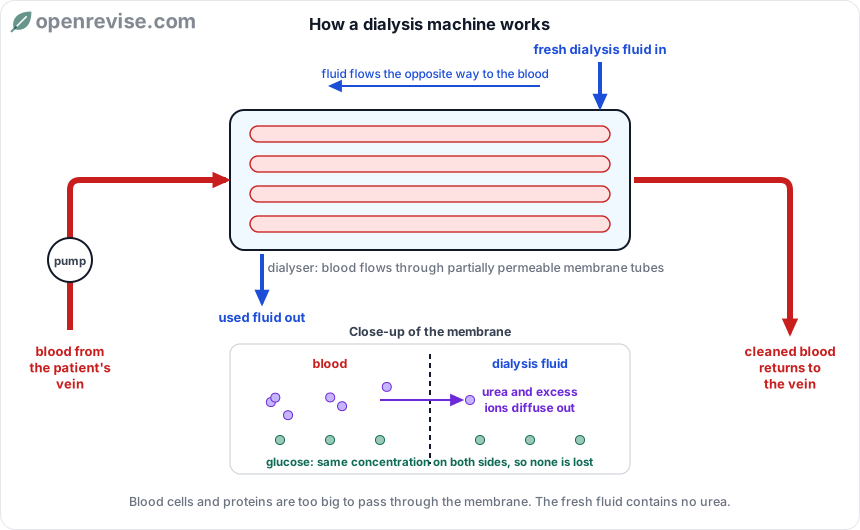
- A tube is put into a vein, usually in the arm. Blood is pumped out of the body and into the dialysis machine.
- Inside the machine, the blood flows through tubes made of a partially permeable membrane.
- Dialysis fluid flows around the tubes, in the opposite direction to the blood. This keeps a steep concentration gradient all along the membrane.
- The dialysis fluid contains the same concentration of glucose and useful ions as normal blood, and no urea.
- Urea and excess ions diffuse out of the blood, through the membrane, into the fluid, down their concentration gradients. Excess water also leaves.
- Glucose and useful ions are not lost, because their concentration is the same on both sides, so there is no net diffusion.
- Blood cells and proteins are too large to pass through the membrane, so they stay in the blood.
- The cleaned blood is returned to the vein. The used fluid is thrown away.
A dialysis session takes about 3 to 4 hours, usually three times a week, either in hospital or at home. Between sessions, patients must carefully control their diet (especially salt and protein) and how much they drink. Heparin is added to stop the blood clotting in the machine.
Kidney transplants
A transplant replaces the failed kidney with a healthy one from a donor. A donor can be a person who has died, or a living person (often a relative), because we can live with one kidney.
- The donor kidney must be a close tissue match, so its antigens are similar to the patient's. Otherwise the patient's immune system would attack it as foreign: rejection.
- After the transplant the patient must take immunosuppressant drugs for the rest of their life to reduce the risk of rejection. These weaken the immune system, so the patient is more likely to get infections.
- A transplanted kidney may last 10 to 20 years or more.
Comparing the treatments
| Feature | Dialysis | Transplant |
|---|---|---|
| Availability | Available to everyone who needs it | Long waiting lists: not enough donors |
| Lifestyle | Several hours, three times a week; strict diet and limited drinks | A normal life; diet is much freer |
| How long it lasts | Needed for life (or until a transplant) | Can last many years, but may eventually fail |
| Risks | Infection where the tube enters; blood clots; changes in blood chemistry between sessions | Rejection; side effects of immunosuppressants, including infections; risks of surgery |
| Cost | High every year it is used (machine, staff, fluid) | High at first (surgery), then the cost of drugs; cheaper than dialysis over several years |
Test yourself on this lesson
6 exam questions · 19 marks · with mark schemes and model answers
Found a mistake?