5.17 The nephron
6 exam questions worth 16 marks. Write your answer, open the mark scheme, then give yourself the marks you earned. Your answers are saved on this device.
0 / 16
The diagram shows a nephron.
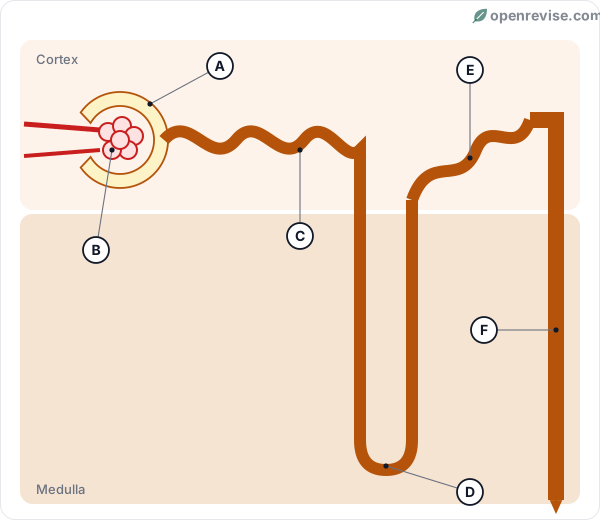
Name parts A, B and F.
Mark scheme
- A: Bowman's capsule (1)
- B: glomerulus (1)
- F: collecting duct (1)
Model answer
A is the Bowman's capsule, B is the glomerulus and F is the collecting duct.
Explain how the structure of the nephron is related to its function in filtering the blood and forming urine.
Mark scheme
Level 3 (5-6): filtration, selective reabsorption and water reabsorption all explained, each linked to the correct part of the nephron and to structure. Level 2 (3-4): most processes linked to the right parts, with limited explanation of structure. Level 1 (1-2): some correct processes or parts named.
Indicative content:
- glomerulus: high pressure / knot of capillaries forces small molecules out
- into the Bowman's capsule (filtration)
- water, glucose, ions, urea filtered; proteins and cells too big
- proximal convoluted tubule: selective reabsorption of all glucose (by active transport)
- coiled / large surface area / many mitochondria
- loop of Henle helps water reabsorption
- collecting duct: water reabsorbed by osmosis, controlled by ADH
- urine: urea, excess water and ions to the ureter
Model answer
Blood enters the glomerulus, a knot of capillaries, at high pressure, so small molecules (water, glucose, ions and urea) are forced out into the Bowman's capsule, while proteins and blood cells are too big and stay in the blood. In the proximal convoluted tubule, which is long and coiled with a large surface area, all the glucose is selectively reabsorbed into the blood by active transport, along with some ions and water. The loop of Henle makes the medulla salty, so water can be reabsorbed by osmosis from the collecting duct, where ADH controls the permeability of the walls. The urea, excess ions and excess water left over form urine, which flows from the collecting duct to the ureter.
Explain why proteins are not found in the Bowman's capsule.
Mark scheme
protein molecules are too large to be filtered / pass out of the glomerulus
Model answer
Protein molecules are too large to be filtered out of the glomerulus.
Glucose is reabsorbed from the proximal convoluted tubule by active transport.
Suggest why the cells lining this tubule contain many mitochondria.
Mark scheme
- active transport needs energy (1)
- mitochondria carry out (aerobic) respiration to release energy (1)
Model answer
Active transport needs energy, and mitochondria carry out respiration, which releases that energy.
In which part of the nephron is all the glucose reabsorbed?
Choose one answer.
Correct Not quite: the answer is Proximal convoluted tubule
Mark scheme
C
Model answer
C: the proximal convoluted tubule.
Describe what happens in the glomerulus and Bowman's capsule.
Mark scheme
- blood is under high pressure (in the glomerulus) (1)
- small molecules / water, glucose, ions and urea are forced out / filtered (1)
- into the Bowman's capsule (1)
- large molecules / proteins / cells stay in the blood (1)
Max 3
Model answer
Blood in the glomerulus is under high pressure, so small molecules such as water, glucose, ions and urea are filtered out into the Bowman's capsule. Large proteins and blood cells stay in the blood.
Found a mistake?