5.17 The nephron
The structure of a nephron (glomerulus, Bowman's capsule, convoluted tubules, loop of Henle, collecting duct) and how each part filters the blood or reabsorbs glucose and water.
Inside the kidney
Key terms
- Nephron: one of about a million tiny tubules in each kidney; the unit that filters the blood and makes urine.
- Glomerulus: a knot of capillaries where blood is filtered at high pressure.
- Bowman's capsule: the cup-shaped start of the nephron that surrounds the glomerulus and collects the filtrate.
- Loop of Henle: the U-shaped part of the nephron that dips into the medulla; it helps the kidney reabsorb water.
- Collecting duct: the tube that carries urine from several nephrons; ADH controls how much water it reabsorbs.
A kidney has an outer layer, the cortex, and an inner layer, the medulla. Each kidney contains about a million nephrons. A nephron starts in the cortex, loops down into the medulla and back, then drains into a collecting duct, which carries urine to the ureter.
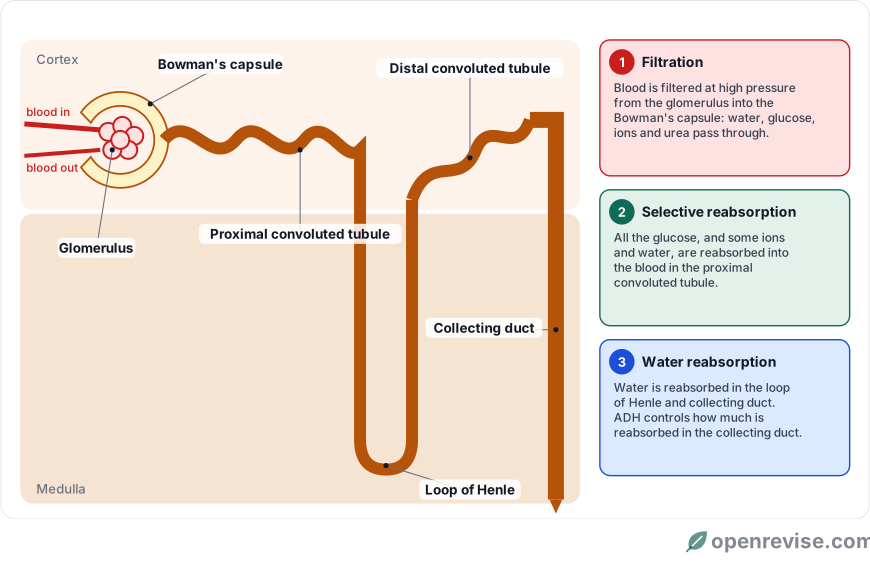
What happens along the nephron
1. Filtration in the glomerulus and Bowman's capsule. Blood enters the glomerulus through an arteriole that is wider than the one leaving it, so the blood is under high pressure. Small molecules (water, glucose, ions and urea) are forced out of the capillaries into the Bowman's capsule. Blood cells and proteins are too big to pass through, so they stay in the blood. The liquid in the capsule is called the filtrate.
2. Selective reabsorption of glucose in the proximal convoluted tubule. The filtrate flows into the first, coiled part of the tubule. Here all the glucose is reabsorbed into the blood capillaries around the tubule, by active transport, along with some ions and water. The coiling, and microvilli on the tubule cells, give a large surface area.
3. Reabsorption of water in the loop of Henle and collecting duct. The loop of Henle makes the tissue of the medulla very salty, so water can be drawn out of the collecting duct by osmosis as urine flows down through the medulla. How much water is reabsorbed in the collecting duct is controlled by the hormone ADH.
4. Urine. The liquid that reaches the end of the collecting duct is urine: urea, excess ions and excess water. It flows to the ureter and then to the bladder.
| Part | What happens there |
|---|---|
| Glomerulus | Blood is filtered at high pressure |
| Bowman's capsule | Collects the filtrate (water, glucose, ions, urea) |
| Proximal convoluted tubule | Selective reabsorption: all the glucose, plus some ions and water |
| Loop of Henle | Makes the medulla salty, so water can be reabsorbed |
| Distal convoluted tubule | More ions reabsorbed, as the body needs |
| Collecting duct | Water reabsorbed, controlled by ADH; carries urine to the ureter |
How the structure suits the function
- Glomerulus: many capillaries give a large surface area, and the high blood pressure forces small molecules out.
- Bowman's capsule: a cup shape surrounds the glomerulus, catching all the filtrate.
- Proximal convoluted tubule: long and coiled, with a large surface area and cells with many mitochondria to supply energy for the active transport of glucose.
- Collecting duct: its walls change how permeable they are to water, under the control of ADH.
Test yourself on this lesson
6 exam questions · 16 marks · with mark schemes and model answers
Found a mistake?