5.9 Defects of the eye
Short sight, long sight, cataracts and colour blindness: what causes them, ray diagrams, and how glasses, contact lenses, laser surgery and lens replacement correct them.
When light does not focus on the retina
Key terms
- Myopia: short-sightedness. Near objects are clear but distant objects are blurred, because light is focused in front of the retina.
- Hyperopia: long-sightedness. Distant objects are clear but near objects are blurred, because light would be focused behind the retina.
- Concave lens: a lens that is thinner in the middle and spreads light rays out (a diverging lens).
- Convex lens: a lens that is thicker in the middle and bends light rays together (a converging lens).
- Cataract: a cloudy area in the lens that blurs vision.
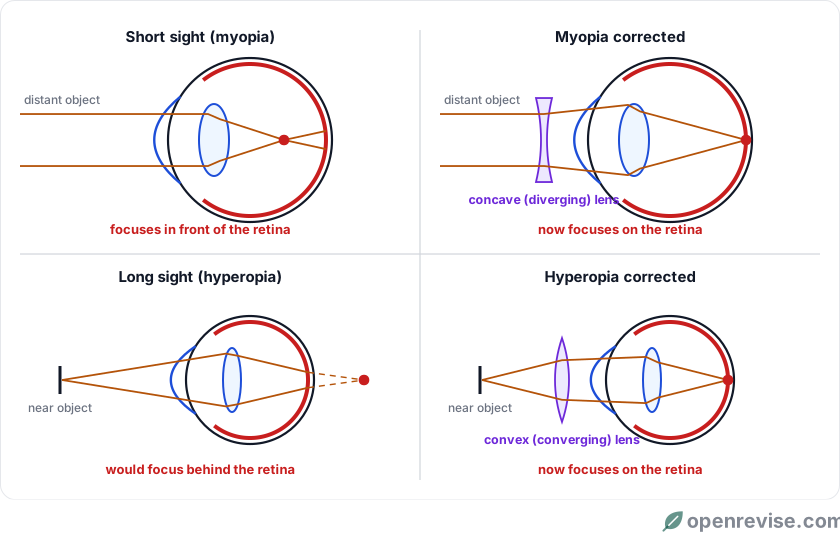
The two most common defects of the eye are myopia and hyperopia. In both, light rays are not focused on the retina, so the image is blurred.
Short-sightedness (myopia)
- Cause: the lens is too thick (too curved), so it refracts light too much, or the eyeball is too long.
- Effect: light from distant objects is focused in front of the retina. By the time it reaches the retina it has spread out again, so distant objects look blurred.
- Correction: a concave (diverging) lens spreads the light rays out a little before they enter the eye, so the eye focuses them further back, on the retina.
Long-sightedness (hyperopia)
- Cause: the lens is too thin (not curved enough), so it does not refract light enough, or the eyeball is too short.
- Effect: light from near objects would be focused behind the retina, so near objects look blurred.
- Correction: a convex (converging) lens starts bending the light rays together before they enter the eye, so they are focused on the retina.
| Feature | Myopia (short sight) | Hyperopia (long sight) |
|---|---|---|
| Can see clearly | Near objects | Distant objects |
| Light focused | In front of the retina | Behind the retina |
| Cause | Lens too thick, or eyeball too long | Lens too thin, or eyeball too short |
| Corrective lens | Concave (diverging) | Convex (converging) |
Treatments for myopia and hyperopia
| Treatment | How it works | Advantages | Disadvantages |
|---|---|---|---|
| Spectacles (glasses) | A lens in a frame refracts light before it enters the eye | Cheap, safe, easy to take off | Can be lost, broken, steam up; some people dislike how they look |
| Contact lenses | A thin lens sits on the cornea. Soft lenses are comfortable; hard lenses last longer and can correct more | Not easily seen; good for sport; wide field of view | Risk of eye infection if not kept clean; must be removed and cleaned; can be uncomfortable |
| Laser eye surgery | A laser reshapes the cornea so it refracts light correctly (flatter for myopia, more curved for hyperopia) | Permanent; no glasses or lenses needed | Costly; risks such as infection, dry eyes, or vision made worse; cannot be reversed |
| Replacement lens surgery | The natural lens is removed and an artificial lens put in | Can correct severe defects; also treats cataracts | Major surgery; risk of infection and damage to the retina; costly |
Cataracts
A cataract is a cloudy patch in the lens. Light cannot pass through it properly, so vision becomes blurred and colours look faded. Cataracts are most common in older people. They are treated by replacing the cloudy lens with an artificial (plastic) lens in a short operation.
Colour blindness
Colour blindness happens when one type of cone cell in the retina does not work properly, so the person cannot tell certain colours apart. Red-green colour blindness is the most common. It is usually inherited and is much more common in males, because the gene is on the X chromosome. There is no cure, but special tinted glasses or contact lenses can help some people tell colours apart.
Test yourself on this lesson
6 exam questions · 14 marks · with mark schemes and model answers
Found a mistake?