3.4 Common infections: cholera, TB, Chalara, malaria and HIV
Edexcel: the five common infections to know (cholera, tuberculosis, Chalara ash dieback, malaria and HIV), the pathogen that causes each, its effects, how it spreads and how the spread can be reduced or prevented.
Five common infections
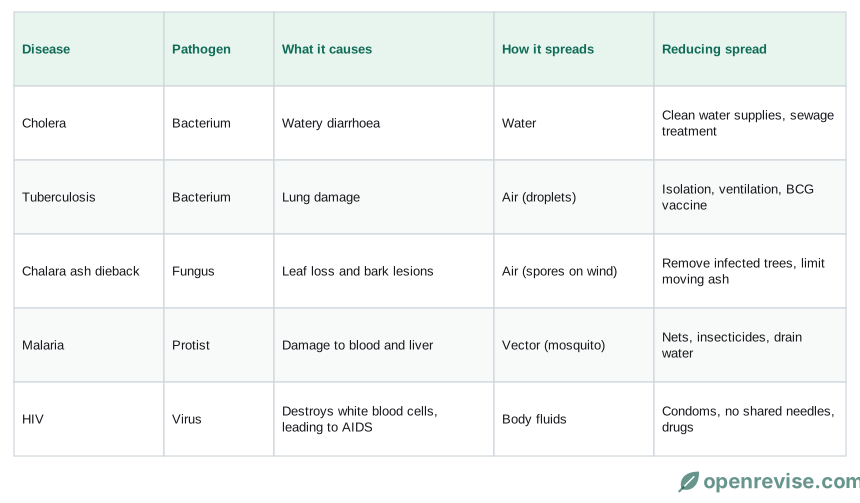
Edexcel asks you to know five communicable diseases: the pathogen, the damage it does, how it spreads and how the spread can be reduced.
Key terms
- Cholera: a bacterial infection, spread in water, causing watery diarrhoea.
- Tuberculosis (TB): a bacterial infection, spread through the air, that damages the lungs.
- Chalara ash dieback: a fungal disease of ash trees causing leaf loss and bark lesions.
- Malaria: a disease caused by a protist and spread by mosquitoes, damaging the blood and liver.
- HIV: a virus that destroys white blood cells, leading to the onset of AIDS.
Cholera (bacterium)
Cholera bacteria release a toxin that causes severe watery diarrhoea, which can kill through dehydration. It spreads in water contaminated with the faeces of infected people. Clean drinking water and proper sewage treatment prevent it.
Tuberculosis (bacterium)
TB bacteria damage the lungs, causing coughing, which can bring up blood. It spreads through the air in droplets when infected people cough. Spread is reduced by isolating infected people, avoiding crowded, poorly ventilated living conditions, the BCG vaccine, and making sure patients finish their full course of antibiotics.
Chalara ash dieback (fungus)
Chalara causes leaf loss and bark lesions (damaged patches) on ash trees, and can kill them. Its spores are carried by the wind, and it also spreads when infected young trees are moved. Spread is reduced by removing infected young trees, replanting with other species, and restricting the import and movement of ash trees.
Malaria (protist)
The malaria protist damages the blood and liver. It is carried by mosquitoes, which are vectors: they pick it up when they bite an infected person and pass it on when they bite someone else. Spread is reduced by mosquito nets, insecticides and draining the standing water where mosquitoes breed.
HIV (virus)
HIV destroys white blood cells, which leads to the onset of AIDS, when the immune system can no longer fight other infections. It spreads in body fluids: through unprotected sex, sharing needles and from mother to baby. Using condoms, not sharing needles, screening donated blood and antiretroviral drugs reduce the spread.
Test yourself on this lesson
6 exam questions · 15 marks · with mark schemes and model answers
Found a mistake?