3.6 Sexually transmitted infections
Edexcel: how the sexually transmitted infections chlamydia (a bacterium) and HIV (a virus) spread, and how their spread can be reduced or prevented with condoms, screening, needle exchanges, blood screening and treatment.
Edexcel
2 min read
What STIs are
Key terms
- Sexually transmitted infection (STI): an infection passed from one person to another during sexual activity.
- Chlamydia: an STI caused by a bacterium. It often has no symptoms but can cause infertility.
- HIV: an STI caused by a virus that destroys white blood cells.
- Screening: testing people who may have an infection, even if they have no symptoms.
STIs are passed on in body fluids, such as semen, vaginal fluids and blood, during unprotected sex. Some can also be passed on in other ways.
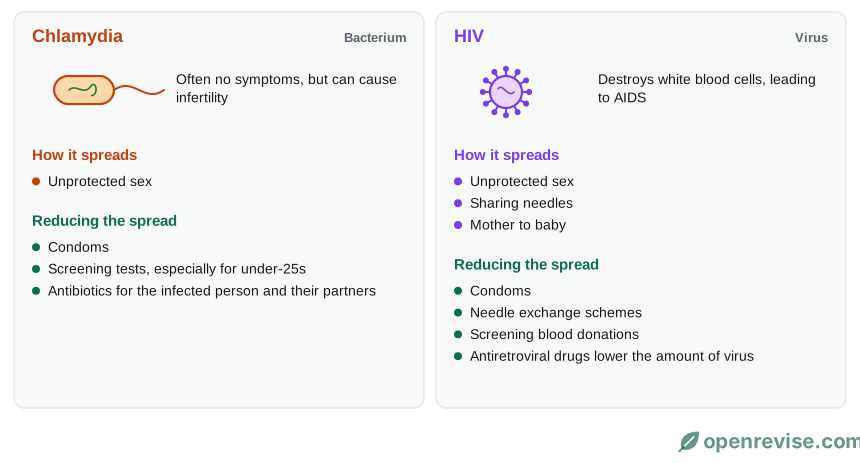
Chlamydia
- Caused by a bacterium.
- Many infected people have no symptoms, so they do not know they have it and can pass it on.
- If it is not treated, it can cause infertility, especially in women.
- Reducing the spread: using condoms, screening (for example, free testing for young people in the UK), treating infected people and their partners with antibiotics, and having fewer sexual partners.
HIV
- Caused by a virus that destroys white blood cells, leading to AIDS.
- It spreads through unprotected sex, by sharing needles (drug users), and from an infected mother to her baby during birth or breastfeeding.
- Reducing the spread: using condoms; needle exchange schemes, so drug users do not share needles; screening blood donations, so infected blood is not used in transfusions; and antiretroviral drugs, which reduce the amount of virus in the body so the person is much less likely to pass it on. These drugs can also be taken to prevent infection.
Why STIs keep spreading
Because many STIs have no symptoms at first, people pass them on without knowing. This is why screening and contact tracing (finding and testing the partners of an infected person) are so important.
Test yourself on this lesson
5 exam questions · 10 marks · with mark schemes and model answers
Found a mistake?