3.7 Human and plant infections
OCR: examples of communicable diseases caused by viruses, bacteria, fungi and protists in humans and plants (HIV/AIDS, TB, athlete's foot, malaria, TMV, Agrobacterium, barley powdery mildew), STIs, and how diseases such as HIV and TB, or HPV and cervical cancer, interact.
Diseases in humans and plants
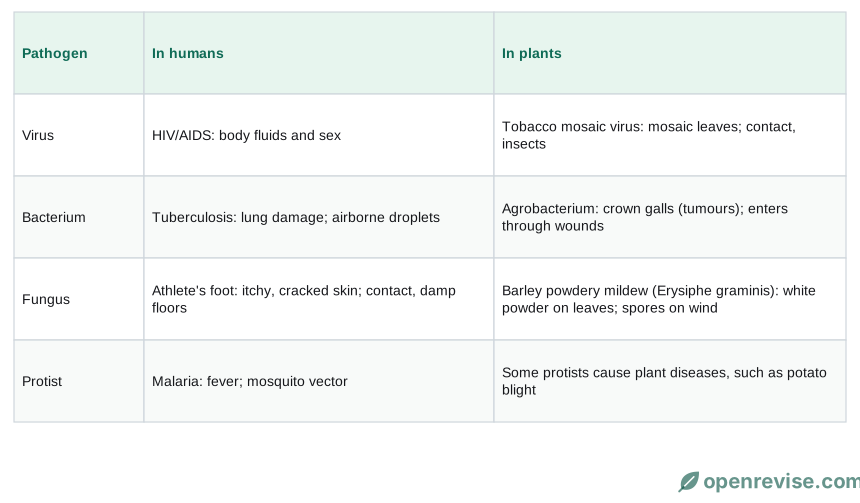
OCR asks for examples of communicable diseases caused by each type of pathogen, in both animals and plants, with how they spread.
Key terms
- Tuberculosis (TB): a bacterial disease that damages the lungs, spread by airborne droplets.
- Agrobacterium: a soil bacterium that enters plants through wounds and causes crown galls (tumour-like growths).
- Barley powdery mildew: a fungal disease of barley caused by Erysiphe graminis, with white powdery patches on the leaves.
- Athlete's foot: a fungal infection of the skin between the toes.
- HPV: human papillomavirus, a sexually transmitted virus that can cause cervical cancer.
Some examples in more detail
- Tobacco mosaic virus (TMV): causes a mosaic of discoloured patches on leaves, so the plant photosynthesises less and grows less. Spread by contact and on tools.
- Tuberculosis: bacteria damage the lungs; spread through the air. Treated with a long course of antibiotics; prevented by the BCG vaccine.
- Agrobacterium tumefaciens: enters a plant through wounds, inserts some of its own DNA into the plant cells and makes them grow into galls.
- Erysiphe graminis (barley powdery mildew): white powdery fungus on the leaves, reducing photosynthesis and crop yield. Spores are carried by the wind. Controlled with fungicides and resistant varieties.
- Athlete's foot: a fungus that grows on warm, damp skin, spread by contact with infected skin or damp floors. Treated with antifungal cream.
- Malaria: a protist carried by mosquitoes, causing repeated fevers.
Sexually transmitted infections
HIV/AIDS is spread in body fluids: by unprotected sex, sharing needles and from mother to baby. HIV attacks white blood cells; without treatment this leads to AIDS. Chlamydia (a bacterium) and HPV (a virus) are other STIs. Condoms, screening and treatment reduce their spread, and girls and boys in the UK are offered an HPV vaccine.
How diseases interact
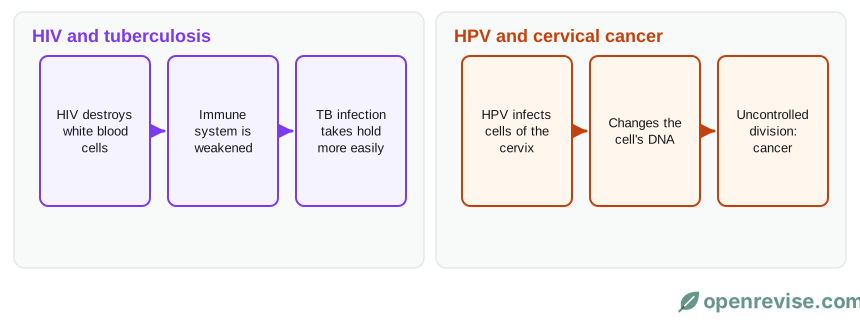
- HIV and TB: HIV weakens the immune system, so people with HIV are much more likely to develop TB. TB is a leading cause of death in people with HIV.
- HPV and cervical cancer: infection with some types of HPV can change the cells of the cervix and lead to cancer. This is why the HPV vaccine is given before people become sexually active.
Reducing the spread
Hygiene, isolating infected people, destroying vectors, vaccination, using condoms, and in plants removing infected plants, controlling insects that carry disease, crop rotation and using healthy seeds and resistant varieties.
Test yourself on this lesson
6 exam questions · 13 marks · with mark schemes and model answers
Found a mistake?