3.12 Discovering and developing drugs
Where drugs come from (digitalis from foxgloves, aspirin from willow, penicillin from mould), and how new drugs are tested for toxicity, efficacy and dose in preclinical and clinical trials, including double blind trials and placebos.
Where drugs come from
Key terms
- Toxicity: how harmful a drug is.
- Efficacy: how well a drug works.
- Dose: the amount of a drug given.
- Placebo: a substance that looks like the drug but has no effect, used to compare with the real drug.
- Double blind trial: a trial in which neither the patients nor the doctors know who is given the drug and who is given the placebo.
Traditionally, drugs were extracted from plants and microorganisms:
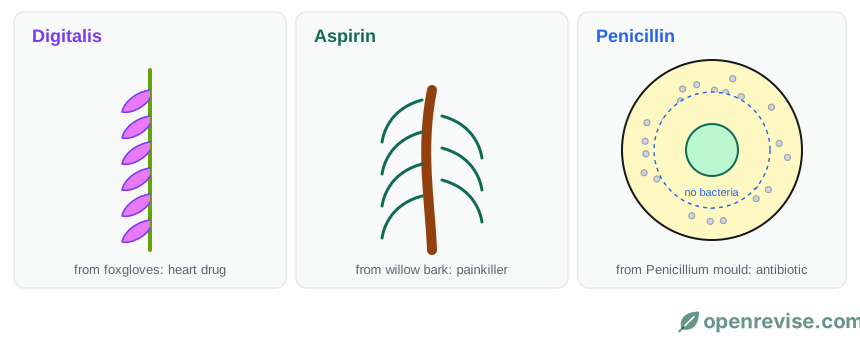
- Digitalis, a heart drug, comes from foxgloves.
- Aspirin, a painkiller, was developed from a chemical in willow bark.
- Penicillin, the first antibiotic, was discovered by Alexander Fleming in 1928, when he noticed that bacteria did not grow around some Penicillium mould on a culture plate.
Most new drugs are now made (synthesised) by chemists in the pharmaceutical industry, though the starting point may still be a chemical found in a plant.
Testing new drugs
A new drug must be tested for toxicity, efficacy and the best dose before it can be used.
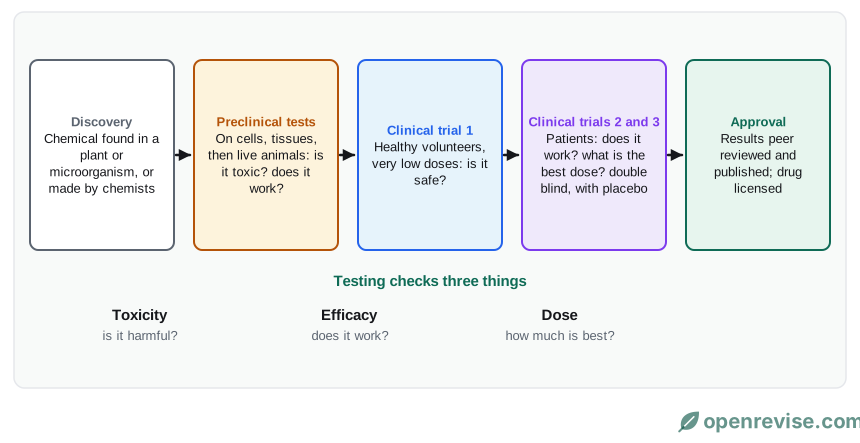
- Preclinical testing in a laboratory, using cells, tissues and live animals.
- Clinical trials on people. First, healthy volunteers are given very low doses to check the drug is safe and look for side effects.
- If it is safe, it is tested on patients with the illness, to see whether it works and to find the optimum dose.
- Results are checked by other scientists (peer review) before they are published, so they are not biased or flawed.
Double blind trials
In many trials, patients are split at random into two groups: one gets the drug and the other gets a placebo. In a double blind trial, neither the patients nor the doctors know who has which, so their expectations cannot affect the results. A placebo is needed because people often feel better just because they think they are being treated.
Test yourself on this lesson
6 exam questions · 12 marks · with mark schemes and model answers
Found a mistake?