3.9 White blood cells and the immune response
6 exam questions worth 12 marks. Write your answer, open the mark scheme, then give yourself the marks you earned. Your answers are saved on this device.
0 / 12
Describe how a phagocyte destroys a pathogen.
Mark scheme
- engulfs / surrounds / ingests the pathogen (1)
- digests it (with enzymes) (1)
Model answer
The phagocyte engulfs the pathogen and digests it with enzymes.
What is an antigen?
Mark scheme
a molecule / protein on the surface of a pathogen / cell (that triggers an immune response)
Model answer
An antigen is a protein on the surface of a pathogen that the immune system recognises as foreign.
Explain why antibodies against the measles virus do not protect against the chickenpox virus.
Mark scheme
- antibodies are specific / have a specific shape (1)
- the chickenpox virus has different antigens (so the antibodies do not fit / bind) (1)
Model answer
Antibodies are specific: their shape only fits the antigens on the measles virus. The chickenpox virus has different antigens, so the measles antibodies cannot bind to it.
Some bacteria produce toxins. How do white blood cells protect the body from these toxins?
Mark scheme
lymphocytes produce antitoxins (which neutralise / bind to the toxins)
Model answer
Lymphocytes make antitoxins, which bind to the toxins and neutralise them.
Explain why a person who has had chickenpox does not usually catch it again.
Mark scheme
- (during the first infection) lymphocytes make antibodies (1)
- memory lymphocytes / memory cells are produced (1)
- if reinfected, memory cells recognise the antigen (1)
- antibodies made faster and in larger amounts / secondary response (1)
- pathogen destroyed before symptoms appear (1)
Maximum 4 marks
Model answer
During the first infection, lymphocytes made antibodies against the chickenpox antigens, and memory lymphocytes were produced. If the virus enters again, the memory lymphocytes recognise its antigens and quickly make large amounts of antibodies. The virus is destroyed before the person feels ill.
Look at the graph of antibody concentration.
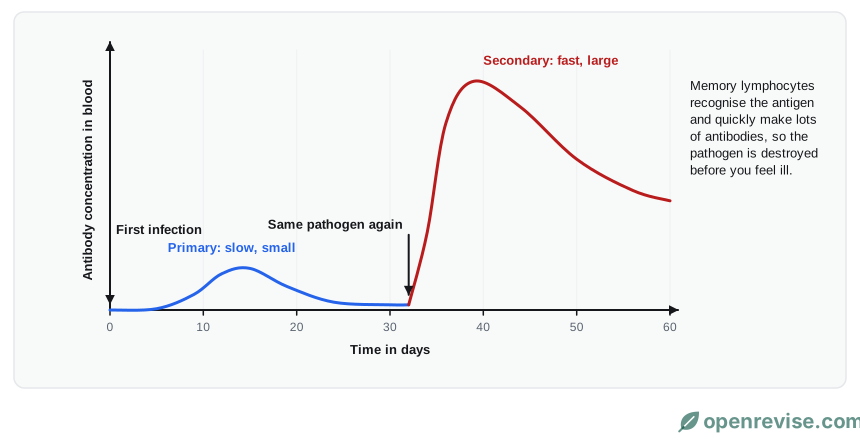
Give two differences between the primary and secondary responses.
Mark scheme
Any two from:
- secondary response is faster / starts sooner (1)
- secondary response produces more antibodies / higher peak (1)
- antibodies stay high for longer in the secondary response (1)
Model answer
The secondary response starts much faster, and it produces a much higher concentration of antibodies.
Found a mistake?