3.14 Uses of monoclonal antibodies
How monoclonal antibodies are used in pregnancy tests, for diagnosis and research, and to treat cancer by carrying drugs or radioactive substances straight to cancer cells, with their advantages and disadvantages.
Why they are useful
Monoclonal antibodies bind to one specific antigen. Scientists can make them for almost any chemical, so they can be used to find or target that chemical, even in a mixture of thousands of others.
Key terms
- hCG: human chorionic gonadotrophin, a hormone only found in the urine of pregnant women.
- Diagnosis: finding out what disease or condition a person has.
1. Pregnancy tests
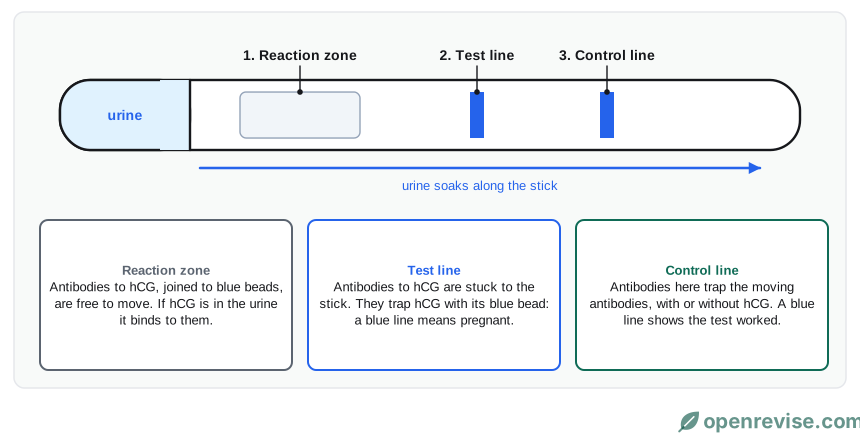
- Urine is put on the end of the stick. In the reaction zone, there are mobile antibodies to hCG, attached to blue beads. If hCG is present, it binds to them.
- At the test line, more antibodies to hCG are fixed to the stick. They trap the hCG with its blue bead, so a blue line appears if the woman is pregnant.
- At the control line, fixed antibodies trap any mobile antibodies that reach them, whether or not hCG is attached. A blue line here shows the test has worked.
2. Diagnosis
In laboratories and hospitals, monoclonal antibodies are used to measure the levels of hormones and other chemicals in the blood, and to detect pathogens. They can also show where blood clots or cancer cells are in the body, when they carry a dye or a radioactive marker.
3. Research
Monoclonal antibodies with a fluorescent dye attached bind to one specific molecule in a cell or tissue. Under a microscope, the glowing dye shows exactly where that molecule is.
4. Treating cancer
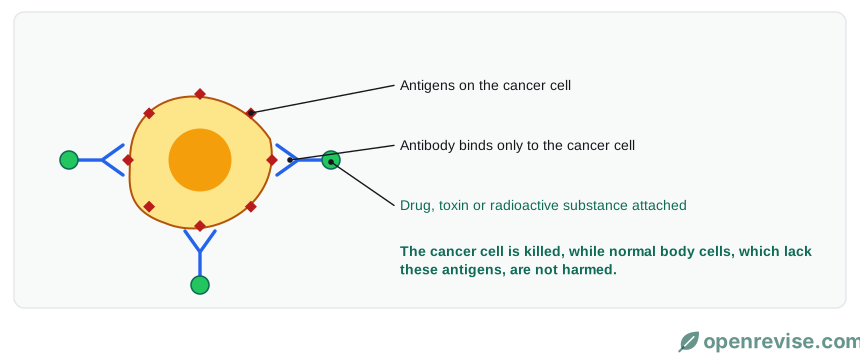
Antibodies are made that bind to antigens found only on cancer cells. A radioactive substance, a toxic drug or a chemical that stops cells growing and dividing is attached. The antibody carries it straight to the cancer cells, so fewer normal cells are harmed than with ordinary chemotherapy. Some antibodies also trigger the immune system to attack the cancer cells.
Advantages and disadvantages
- Advantages: very specific, so they target only the cells or chemicals wanted; they can treat a wide range of conditions.
- Disadvantages: they have caused more side effects than expected, such as fever, vomiting and low blood pressure. They are also expensive to make, so they are not yet as widely used as scientists first hoped.
Test yourself on this lesson
5 exam questions · 13 marks · with mark schemes and model answers
Found a mistake?