6.8 Inherited disorders and embryo screening
AQA: polydactyly (caused by a dominant allele) and cystic fibrosis (caused by a recessive allele), working out the chance of a child inheriting them, embryo screening, and the economic, social and ethical issues it raises.
AQA
2 min read
Two inherited disorders
Key terms
- Inherited disorder: a condition caused by an allele passed on from parents.
- Carrier: a person with one copy of a recessive allele for a disorder, who does not have the disorder.
- Embryo screening: testing embryos for genetic disorders before they are implanted or born.
| Disorder | Caused by | Effect | Who has it |
|---|---|---|---|
| Polydactyly | A dominant allele | Extra fingers or toes | Anyone with at least one dominant allele (Dd or DD) |
| Cystic fibrosis | A recessive allele | A disorder of cell membranes: thick, sticky mucus in the lungs and digestive system | Only people with two recessive alleles (ff) |
Working out the chances
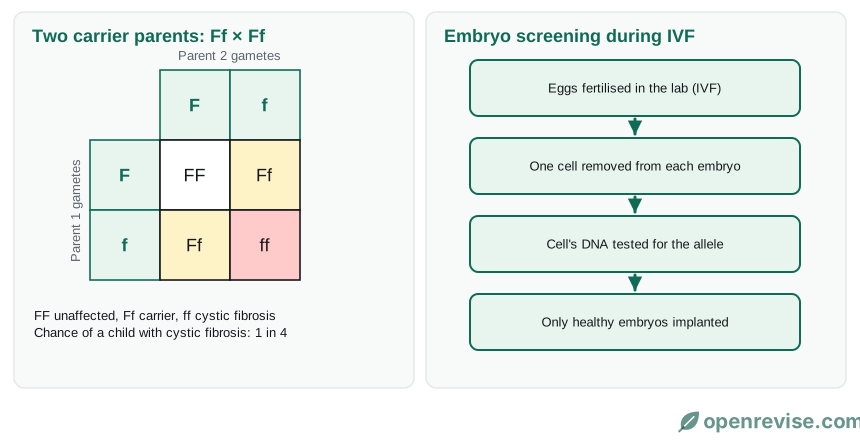
- Two carriers (Ff × Ff) have a 1 in 4 chance of a child with cystic fibrosis, and a 1 in 2 chance of a child who is a carrier.
- A parent with polydactyly who is heterozygous (Dd) and an unaffected parent (dd) have a 1 in 2 chance of a child with polydactyly. Only one parent needs the allele, because it is dominant.
Embryo screening
Embryos made by IVF can be tested: one cell is removed and its DNA is checked for the faulty allele. Only embryos without the disorder are implanted. Scientists are also researching gene therapy, which could correct faulty alleles.
Is it right?
| For | Against |
|---|---|
| Prevents suffering from a serious disorder | Embryos that are rejected are destroyed, which some people think is wrong |
| Lowers the cost of lifelong treatment and care | It is expensive, and may give false results |
| Parents can make informed choices | Fears it could lead to "designer babies" chosen for other characteristics |
Questions may ask you to evaluate these economic (cost), social (effects on families and society) and ethical (right and wrong) issues.
Test yourself on this lesson
5 exam questions · 13 marks · with mark schemes and model answers
Found a mistake?