6.7 Genetic terms and monohybrid crosses
The key terms of genetics (allele, dominant, recessive, homozygous, heterozygous, genotype, phenotype), how to draw Punnett squares for single-gene crosses, work out ratios and probabilities, and read family trees.
Key terms
Key terms
- Allele: a different version of the same gene.
- Dominant: an allele that is always expressed, even if only one copy is present (capital letter, e.g. B).
- Recessive: an allele that is only expressed if two copies are present (lower-case letter, e.g. b).
- Homozygous: having two identical alleles (BB or bb).
- Heterozygous: having two different alleles (Bb).
- Genotype: the alleles an organism has (e.g. Bb).
- Phenotype: the characteristic that is shown (e.g. brown eyes).
Most characteristics are controlled by many genes interacting. A few are controlled by a single gene, such as fur colour in mice and red-green colour blindness in humans. These are the ones we can model with simple crosses.
Drawing a cross
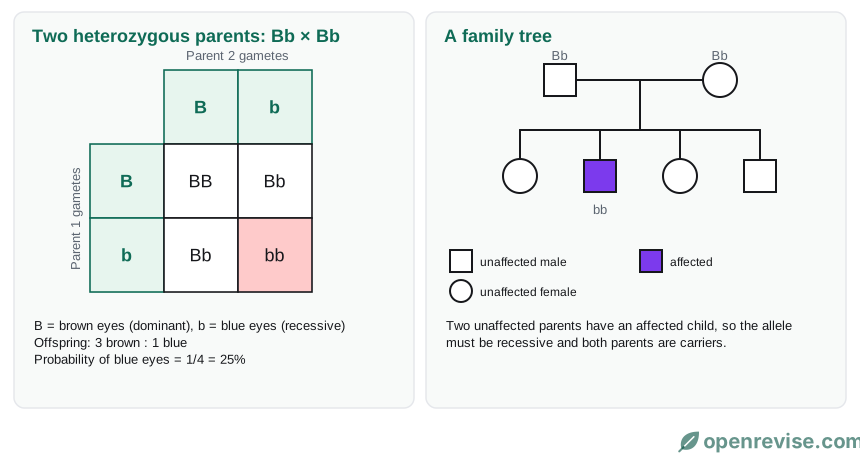
- Write the parents' genotypes (Bb × Bb).
- Write each parent's possible gametes (B or b) along the top and side of a Punnett square.
- Fill in the offspring genotypes.
- Work out the phenotypes, the ratio and the probability.
From Bb × Bb: genotypes 1 BB : 2 Bb : 1 bb, phenotypes 3 brown : 1 blue. The probability of a blue-eyed child is 1 in 4 (0.25, 25%).
Other common crosses:
- Bb × bb gives 1 Bb : 1 bb, a 1 : 1 ratio (50% chance of each).
- BB × bb gives all Bb: every child shows the dominant phenotype.
Family trees (pedigrees)
Squares are males and circles are females; shaded symbols are affected. If two unaffected parents have an affected child, the allele must be recessive, and both parents must be heterozygous carriers.
Test yourself on this lesson
6 exam questions · 13 marks · with mark schemes and model answers
Found a mistake?