6.12 The Human Genome Project
Edexcel and OCR: what the Human Genome Project achieved, how knowing the human genome is used in medicine (finding disease alleles, genetic testing, personalised drugs), and the problems and ethical concerns it raises.
Edexcel
OCR
1 min read
The project
Key terms
- Human Genome Project: an international project, completed in 2003, that worked out the order of all the bases in human DNA and located the human genes.
- Personalised medicine: choosing a treatment to suit a person's genotype.
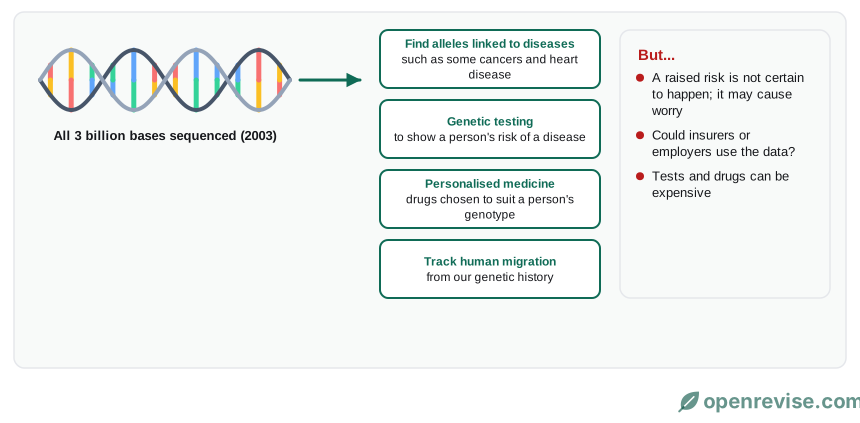
Scientists from many countries worked together for over ten years to sequence all 3 billion base pairs of the human genome. They found about 20 000 genes, far fewer than expected.
Uses in medicine
- Finding alleles linked to disease: scientists can compare the genomes of people with and without a disease to find the variants that raise the risk, for example of some breast cancers, heart disease or type 2 diabetes.
- Genetic testing: people can be tested to see if they carry an allele linked to a disease. They can then change their lifestyle, or have more frequent check-ups to catch the disease early.
- Personalised medicine: some drugs work well in people with one variant but not another. Knowing a patient's genotype helps doctors choose the right drug and dose, with fewer side effects.
- New treatments: understanding which gene causes a disorder is the first step to new drugs or gene therapy.
Problems and concerns
- A test shows increased risk, not certainty, so it can cause worry about something that never happens, or false reassurance.
- People worry that insurance companies or employers could use genetic information unfairly.
- Testing and personalised drugs can be expensive.
- Some people may not want to know their risk of a disease that cannot be treated.
Test yourself on this lesson
5 exam questions · 8 marks · with mark schemes and model answers
Found a mistake?