2.3 Factors affecting enzyme activity
How temperature, pH, substrate concentration and enzyme concentration change the rate of an enzyme-controlled reaction, what an optimum is, and how to calculate a rate of reaction.
Key terms
Key terms
- Optimum: the temperature or pH at which an enzyme works fastest.
- Rate of reaction: how much substrate is used up, or product made, in a given time.
- Denatured: the active site has changed shape, so the substrate no longer fits.
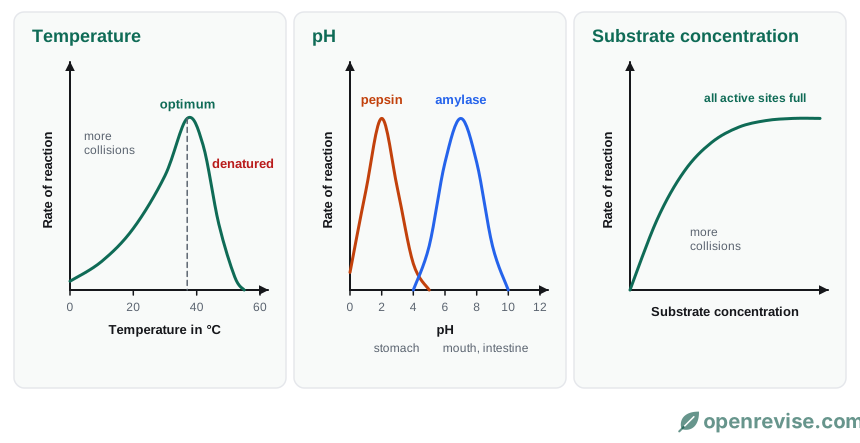
Temperature
- As the temperature rises, enzyme and substrate molecules have more kinetic energy. They move faster and collide more often, so more enzyme–substrate complexes form and the rate increases.
- The rate is fastest at the optimum temperature. For most human enzymes this is about 37 °C, body temperature.
- Above the optimum, the bonds holding the enzyme's shape break. The active site changes shape and the enzyme is denatured, so the rate falls quickly to zero.
pH
Each enzyme has an optimum pH. A pH far from it changes the shape of the active site, so the substrate no longer fits, and the enzyme is denatured.
| Enzyme | Where it works | Optimum pH |
|---|---|---|
| Pepsin (a protease) | Stomach | about 2 (acidic) |
| Amylase | Mouth and small intestine | about 7 (neutral) |
| Lipase and trypsin | Small intestine | about 8 (slightly alkaline) |
Substrate and enzyme concentration
- Substrate concentration: more substrate means more collisions with active sites, so the rate increases. Eventually every active site is occupied all the time. The rate levels off, because the enzyme is working as fast as it can. Adding more enzyme would now speed it up.
- Enzyme concentration: more enzyme means more active sites, so the rate increases, as long as there is plenty of substrate.
Calculating the rate
The rate is the amount of product made (or substrate used) divided by the time taken.
For example, if an enzyme makes 24 cm3 of oxygen in 2 minutes, the rate is 24 ÷ 2 = 12 cm3 per minute. When you only know the time taken for a reaction to finish, you can use 1000 ÷ time as a measure of rate (in s-1). From a graph, the rate at any moment is the gradient of the curve: draw a tangent and divide the change in y by the change in x.
Test yourself on this lesson
7 exam questions · 16 marks · with mark schemes and model answers
Found a mistake?