2.4 Required practical: pH and amylase
The required practical for the effect of pH on amylase: the starch and iodine continuous sampling method, variables, how to calculate rate as 1000 divided by time, and how to make the results more accurate.
AQA
Edexcel
OCR
2 min read
The aim
To find out how pH affects the rate at which amylase breaks down starch. This is AQA required practical 5, Edexcel core practical 1.10 and part of OCR PAG B4.
Key terms
- Independent variable: the pH (changed using buffer solutions).
- Dependent variable: the time taken for the starch to be broken down.
- Control variables: temperature, volume and concentration of amylase and of starch, volume of buffer.
- Buffer solution: a solution that keeps the pH constant.
Method
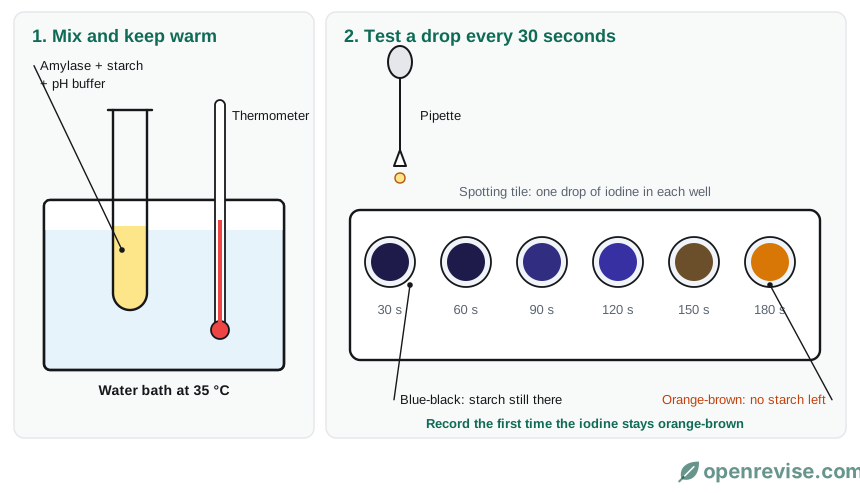
- Put one drop of iodine solution into each well of a spotting tile.
- Put a test tube containing 2 cm3 of amylase, one containing 2 cm3 of starch solution and 1 cm3 of pH buffer into a water bath at 35 °C. Leave them for 5 minutes to reach the temperature.
- Mix the solutions in one tube and start a stopwatch. Keep the tube in the water bath.
- Every 30 seconds, use a pipette to put one drop of the mixture into a new well of iodine.
- While starch is still there, the iodine turns blue-black. Record the time when the iodine stays orange-brown: all the starch has been broken down.
- Repeat with buffers of different pH, such as pH 4, 5, 6, 7, 8 and 9. Repeat each pH three times and find a mean.
Results
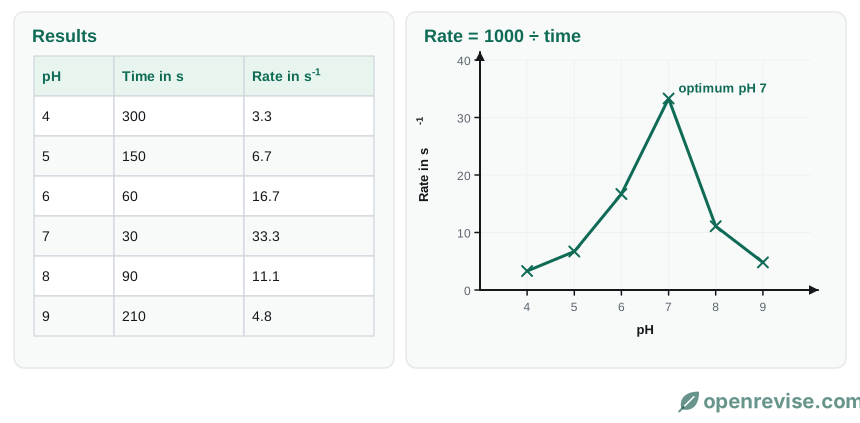
rate = 1000 / time
Work out a rate for each pH (in s-1) and plot rate against pH. The highest point shows the optimum pH. At pH values far from the optimum, the active site of the amylase changes shape, so the starch is broken down slowly or not at all.
Making it better
- Sampling every 30 seconds means the time is only known to the nearest 30 seconds. Sampling every 10 seconds gives a more accurate result.
- Deciding when the colour has changed is a judgement. Compare with a colour chart, or use a colorimeter.
- Rinse the pipette between drops, so you do not carry starch over.
Test yourself on this lesson
7 exam questions · 17 marks · with mark schemes and model answers
Found a mistake?