2.5 The digestive system and digestive enzymes
7 exam questions worth 16 marks. Write your answer, open the mark scheme, then give yourself the marks you earned. Your answers are saved on this device.
0 / 16
The diagram shows the human digestive system.
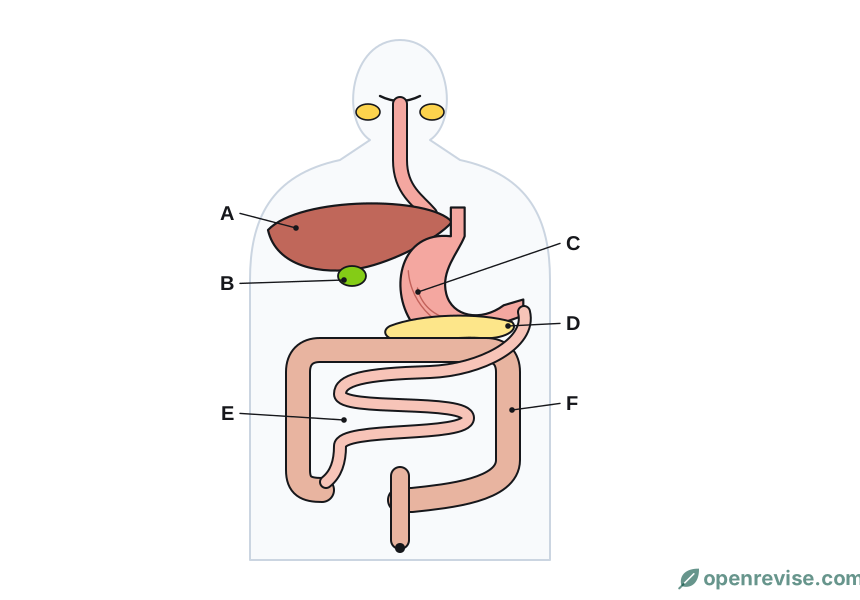
Give the letter of:
- the organ that makes bile
- the organ that makes lipase, protease and amylase
- the organ where water is absorbed
Mark scheme
- A (liver) (1)
- D (pancreas) (1)
- F (large intestine) (1)
Model answer
A makes bile (liver). D makes lipase, protease and amylase (pancreas). F absorbs water (large intestine).
Complete the sentence.
Lipase breaks down lipids into ______ and ______.
Mark scheme
- fatty acids (1)
- glycerol (1)
Model answer
Lipase breaks down lipids into fatty acids and glycerol.
What are the products of protein digestion?
Choose one answer.
Correct Not quite: the answer is Amino acids
Mark scheme
C: amino acids
Model answer
C: amino acids. Proteases break proteins down into amino acids.
Name the organ where bile is made and the organ where it is stored.
Mark scheme
- made: liver (1)
- stored: gall bladder (1)
Model answer
Bile is made in the liver and stored in the gall bladder.
Explain how bile helps the digestion of fats in the small intestine.
Mark scheme
- bile is alkaline (1)
- neutralises (hydrochloric) acid from the stomach / gives the best pH for enzymes in the small intestine (1)
- bile emulsifies fats / breaks fat into small droplets (1)
- giving a larger surface area for lipase (so faster digestion) (1)
Model answer
Bile is alkaline, so it neutralises the acid from the stomach and gives the alkaline conditions that lipase works best in. Bile also emulsifies fat into small droplets, which gives a larger surface area for lipase to act on, so the fat is digested faster.
Explain why starch must be digested before it can be used by the body.
Mark scheme
- starch molecules are (too) large / insoluble (1)
- so cannot be absorbed into the blood / pass through the gut wall (until broken into sugars) (1)
Model answer
Starch molecules are too large to pass through the wall of the small intestine into the blood. They must be broken down into small, soluble sugars first.
Give two ways the body uses the products of digestion.
Mark scheme
Any two from:
- to build new carbohydrates / lipids / proteins (1)
- glucose used in respiration (1)
- amino acids used to make proteins / enzymes (1)
Model answer
Glucose is used in respiration, and amino acids are used to build new proteins.
Found a mistake?