2.5 The digestive system and digestive enzymes
The organs of the digestive system, the three groups of digestive enzymes (carbohydrases, proteases and lipases), where they are made and what they produce, and how bile helps digestion.
Why we digest food
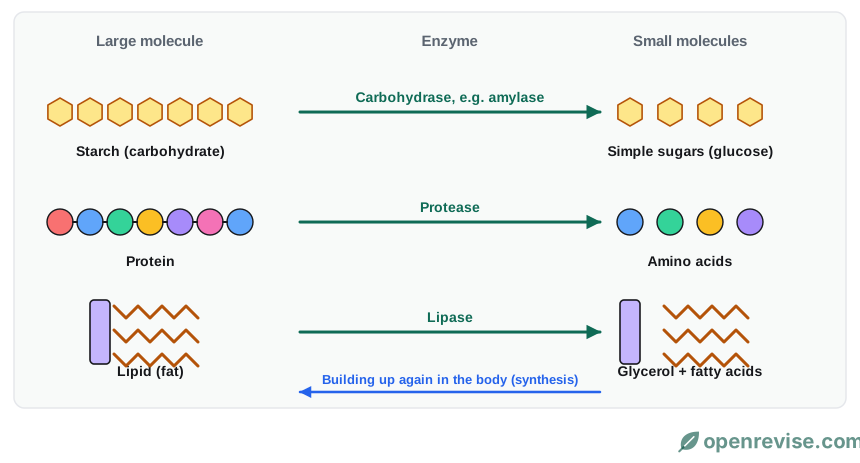
Food contains large molecules such as starch, proteins and lipids. They are too big to pass through the wall of the gut into the blood. Digestive enzymes break them into small, soluble molecules that can be absorbed. The body then uses these small molecules to build new carbohydrates, lipids and proteins, and some of the glucose is used in respiration.
Key terms
- Carbohydrase: an enzyme that breaks down carbohydrates into simple sugars. Amylase is a carbohydrase that breaks down starch.
- Protease: an enzyme that breaks down proteins into amino acids.
- Lipase: an enzyme that breaks down lipids (fats and oils) into fatty acids and glycerol.
- Bile: an alkaline liquid made in the liver and stored in the gall bladder. It neutralises stomach acid and emulsifies fats.
The digestive system
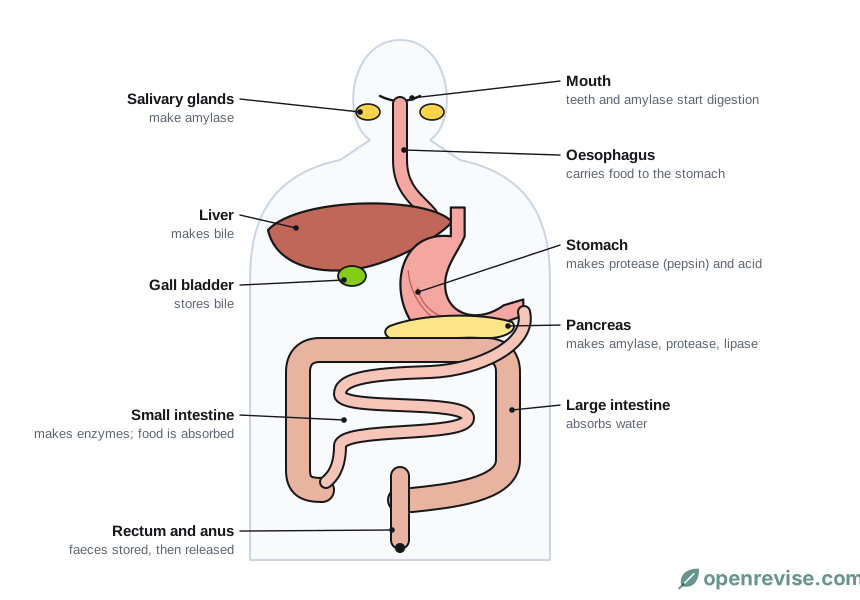
The digestive enzymes
| Enzyme | Breaks down | Into | Made in |
|---|---|---|---|
| Amylase (a carbohydrase) | Starch | Sugars (maltose, then glucose) | Salivary glands, pancreas, small intestine |
| Protease | Proteins | Amino acids | Stomach (pepsin), pancreas, small intestine |
| Lipase | Lipids | Fatty acids and glycerol | Pancreas, small intestine |
Starch, proteins and lipids are polymers, or are built from smaller units: starch is a chain of glucose molecules, proteins are chains of amino acids, and a lipid is made of glycerol joined to fatty acids. Digestion breaks the bonds between the units. Inside cells, enzymes join the units back together to synthesise the molecules the body needs.
Bile
Bile is not an enzyme. It does two jobs in the small intestine:
- It is alkaline, so it neutralises the hydrochloric acid from the stomach. This gives the alkaline conditions the enzymes in the small intestine work best in.
- It emulsifies fats: it breaks large drops of fat into many small droplets. This gives a much larger surface area for lipase to act on, so fats are digested faster.
Test yourself on this lesson
7 exam questions · 16 marks · with mark schemes and model answers
Found a mistake?