2.1 Cells, tissues, organs and organ systems
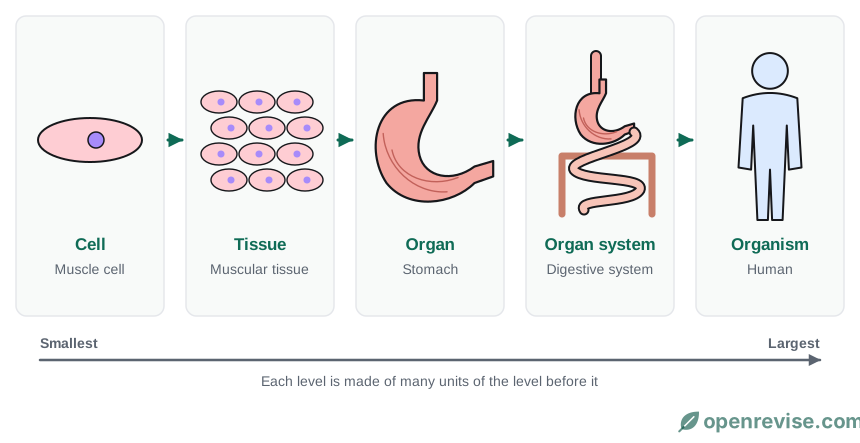
How large multicellular organisms are organised: cells form tissues, tissues form organs, organs form organ systems, and organ systems make up the whole organism, with examples from humans and plants.
Levels of organisation
Key terms
- Cell: the basic building block of all living organisms.
- Tissue: a group of cells with a similar structure and function.
- Organ: a group of different tissues working together to perform a specific function.
- Organ system: a group of organs working together to perform a particular function.
- Organism: a whole living thing, made of organ systems working together.
A single-celled organism, such as a bacterium, does everything in one cell. Large multicellular organisms, such as humans and trees, are built up in levels. Cells that are specialised for the same job are grouped into tissues, tissues into organs, and organs into organ systems.
Tissues
| Tissue | Found in | What it does |
|---|---|---|
| Muscular tissue | Animals (wall of the stomach, heart) | Contracts to move things, such as churning food in the stomach |
| Glandular tissue | Animals (stomach, pancreas, salivary glands) | Makes and releases substances such as enzymes and hormones |
| Epithelial tissue | Animals (lining of the stomach and gut) | Covers the inside and outside of organs |
| Palisade mesophyll | Plants (leaf) | Carries out photosynthesis |
| Xylem and phloem | Plants (roots, stem, leaves) | Transport water, mineral ions and sugars |
Organs
An organ contains several different tissues. The stomach is an organ because it contains:
- muscular tissue, which contracts to churn the food and mix it with digestive juices
- glandular tissue, which makes digestive juices containing acid and enzymes
- epithelial tissue, which covers the inside and outside of the stomach.
In plants, the leaf, stem and root are organs.
Organ systems
Organs work together in organ systems. In the digestive system, the stomach, small intestine, liver and pancreas all help to break down food and absorb it into the blood. Other organ systems include the circulatory system (heart and blood vessels), the gas exchange system (lungs) and the nervous system. In plants, the roots, stem and leaves form a system that transports water and sugars.
Test yourself on this lesson
7 exam questions · 14 marks · with mark schemes and model answers
Found a mistake?