1.18 Active transport
How active transport moves substances against a concentration gradient using energy from respiration: mineral ions in root hair cells and glucose in the gut, why mitochondria matter, and a comparison with diffusion and osmosis.
What is active transport?
Key terms
- Active transport: the movement of substances from a more dilute solution to a more concentrated solution, against a concentration gradient, using energy from respiration.
- Concentration gradient: the difference in concentration between two regions.
- Carrier protein: a protein in a cell membrane that picks up a particular substance and moves it across.
- Mineral ions: dissolved salts, such as nitrate and magnesium, that plants need for healthy growth.
Diffusion and osmosis move substances down a concentration gradient and need no energy. Sometimes a cell needs to take in a substance when its concentration outside is lower than inside. Diffusion would move it the wrong way, so the cell uses active transport.
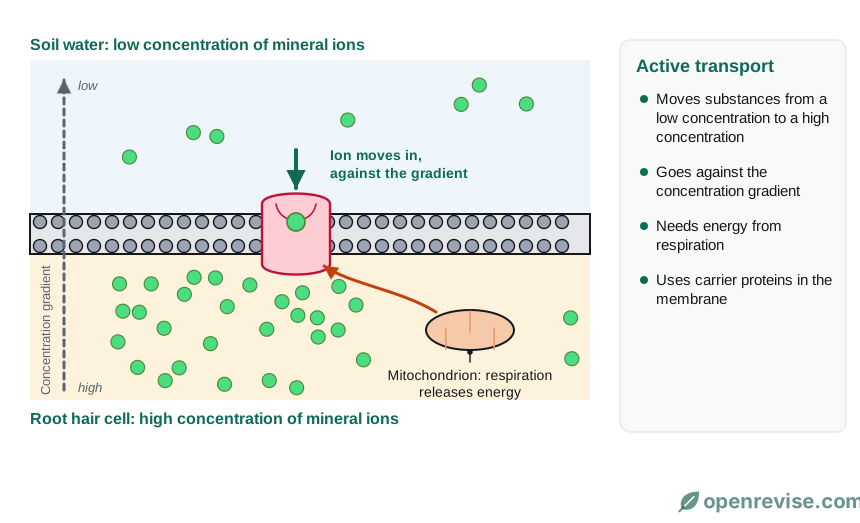
- Active transport moves substances from a low concentration to a high concentration: against the concentration gradient.
- It needs energy from respiration. The energy is released by mitochondria, so cells that do a lot of active transport have many mitochondria.
- It uses carrier proteins in the cell membrane. The substance attaches to a carrier protein, and energy is used to move it across the membrane.
Examples
Mineral ions in root hair cells. The concentration of mineral ions, such as nitrate, in the soil water is very low. It is higher inside the root hair cells. Active transport lets the root hair cells take up the ions against the concentration gradient. Plants need these ions for healthy growth: for example, nitrate to make amino acids and proteins, and magnesium to make chlorophyll.
Glucose in the gut. After a meal, glucose moves from the small intestine into the blood by diffusion. When the concentration of glucose in the gut becomes lower than in the blood, active transport moves the rest of the glucose into the blood. The cells then use the glucose for respiration.
What affects active transport?
Active transport depends on respiration, so anything that slows respiration slows active transport. For example, if the soil is waterlogged, there is little oxygen. The root cells cannot respire aerobically, so they cannot release enough energy to take in mineral ions, and the plant may grow poorly or die.
Comparing the three processes
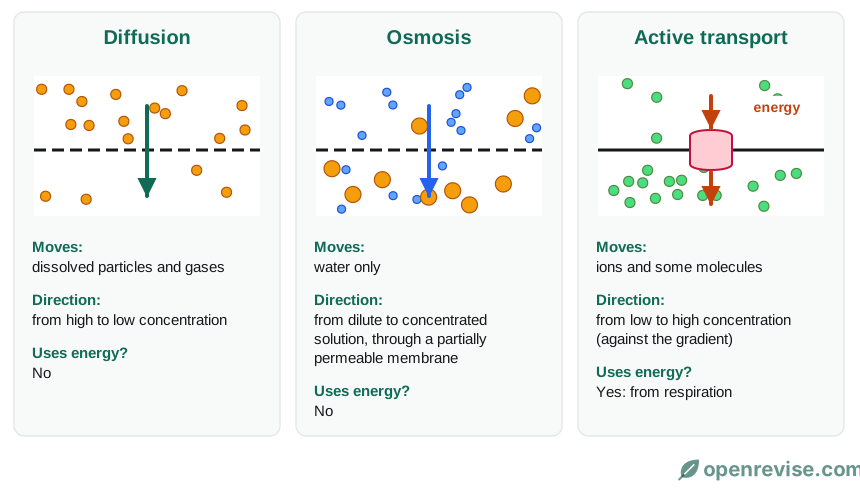
| Feature | Diffusion | Osmosis | Active transport |
|---|---|---|---|
| What moves | Dissolved particles and gases | Water only | Ions and some molecules |
| Direction | From high to low concentration | From a dilute to a concentrated solution | From low to high concentration |
| Membrane needed | No | Yes, partially permeable | Yes, with carrier proteins |
| Energy from respiration | No | No | Yes |
Test yourself on this lesson
7 exam questions · 17 marks · with mark schemes and model answers
Found a mistake?