2.12 Blood
6 exam questions worth 12 marks. Write your answer, open the mark scheme, then give yourself the marks you earned. Your answers are saved on this device.
0 / 12
The diagram shows a blood smear seen with a microscope.
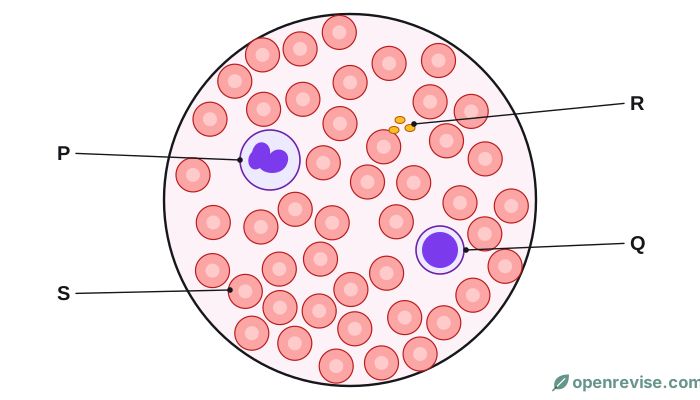
Identify cells P, Q, R and S.
Mark scheme
- P: phagocyte / white blood cell (1)
- Q: lymphocyte / white blood cell (1)
- R: platelets (1)
- S: red blood cell (1)
Model answer
P is a phagocyte (white blood cell with a lobed nucleus), Q is a lymphocyte (white blood cell with a large round nucleus), R is platelets and S is a red blood cell.
Give two ways a red blood cell is adapted to carry oxygen.
Mark scheme
Any two from:
- biconcave (disc) shape / large surface area (for diffusion) (1)
- no nucleus so more room for haemoglobin (1)
- contains haemoglobin which binds oxygen (1)
- small / flexible to pass through capillaries (1)
Model answer
It has no nucleus, so there is more room for haemoglobin to carry oxygen, and its biconcave shape gives a large surface area for oxygen to diffuse in and out.
Name two substances carried in the plasma, and say where each is carried to.
Mark scheme
Any two from:
- carbon dioxide to the lungs (1)
- urea to the kidneys (1)
- glucose / amino acids (from the small intestine) to body cells (1)
- hormones to target organs (1)
Model answer
Plasma carries carbon dioxide to the lungs and urea to the kidneys.
What is the function of platelets?
Mark scheme
help the blood (to) clot
Model answer
Platelets help the blood to clot at a wound.
Which substance in red blood cells combines with oxygen?
Choose one answer.
Correct Not quite: the answer is Haemoglobin
Mark scheme
B: haemoglobin
Model answer
B: haemoglobin, which forms oxyhaemoglobin in the lungs.
A person has a lower than normal number of white blood cells.
Suggest how this would affect them.
Mark scheme
- more likely to get infections / ill (1)
- because fewer pathogens are engulfed / fewer antibodies made (1)
Model answer
They would be more likely to catch infections, because there would be fewer phagocytes to engulf pathogens and fewer lymphocytes to make antibodies.
Found a mistake?