2.12 Blood
The four parts of the blood: plasma, red blood cells, white blood cells and platelets, what each does, how red blood cells are adapted to carry oxygen, and how to recognise each in a blood smear.
What blood is made of
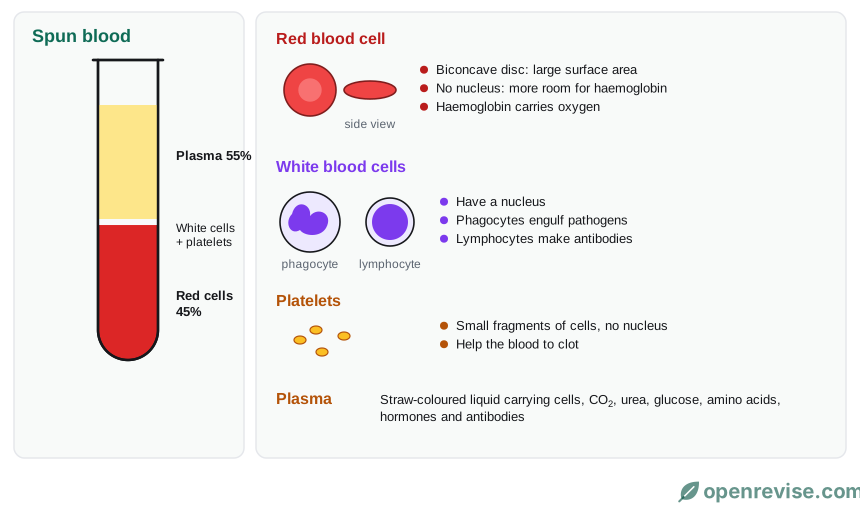
Blood is a tissue. It is made of cells and cell fragments carried in a liquid called plasma. If blood is spun in a centrifuge, it separates into layers.
Key terms
- Plasma: the liquid part of the blood, which carries the cells and dissolved substances.
- Red blood cell: a cell that carries oxygen from the lungs to the body cells.
- White blood cell: a cell that defends the body against pathogens.
- Platelet: a small fragment of a cell that helps the blood to clot.
- Haemoglobin: the red protein in red blood cells that joins with oxygen.
Plasma
Plasma is a straw-coloured liquid, mostly water. It transports:
- the blood cells and platelets
- carbon dioxide from the organs to the lungs
- urea from the liver to the kidneys
- digested food such as glucose and amino acids from the small intestine to all cells
- hormones, antibodies and heat.
Red blood cells
In the lungs, oxygen joins with haemoglobin to form oxyhaemoglobin. In the body's tissues, it splits again and the oxygen is released. Red blood cells are adapted to do this well:
- they are biconcave discs: their shape gives a large surface area, so oxygen diffuses in and out quickly
- they have no nucleus, so there is more room for haemoglobin
- they are small and flexible, so they can squeeze through narrow capillaries.
White blood cells and platelets
White blood cells have a nucleus. They are part of the immune system: phagocytes engulf and digest pathogens, and lymphocytes make antibodies. You meet them again in the topic on infection and response.
Platelets are tiny fragments of cells with no nucleus. At a wound they help the blood clot, which stops bleeding and keeps out pathogens.
Recognising cells in a blood smear
In a stained blood smear seen with a microscope, red blood cells are the most common: pink discs with a paler centre. White blood cells are larger and much rarer, with a purple-stained nucleus. A phagocyte has a lobed nucleus; a lymphocyte has a large round nucleus that nearly fills the cell. Platelets are tiny specks.
Test yourself on this lesson
6 exam questions · 12 marks · with mark schemes and model answers
Found a mistake?