2.9 The heart
7 exam questions worth 16 marks. Write your answer, open the mark scheme, then give yourself the marks you earned. Your answers are saved on this device.
0 / 16
The diagram shows the heart.
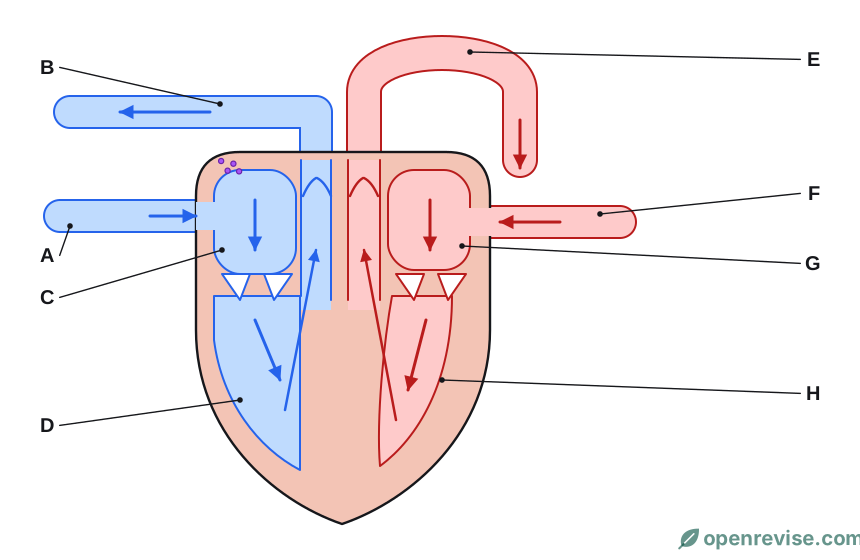
Give the letter of:
- the aorta
- the left ventricle
- the blood vessel that carries blood to the lungs
Mark scheme
- E (1)
- H (1)
- B (1)
Model answer
E is the aorta, H is the left ventricle and B is the pulmonary artery, which carries blood to the lungs.
Explain why the human circulatory system is described as a double circulatory system.
Mark scheme
- blood passes through the heart twice (in each complete circuit) (1)
- one circuit to the lungs and one to the (rest of the) body (1)
Model answer
The blood passes through the heart twice on each circuit: once in a circuit to the lungs, and once in a circuit to the rest of the body.
Explain why the wall of the left ventricle is thicker than the wall of the right ventricle.
Mark scheme
- left ventricle pumps blood to the (whole) body / right ventricle only to the lungs (1)
- so it must pump at a higher pressure / with more force (1)
Model answer
The left ventricle pumps blood all round the body, while the right ventricle only pumps it to the nearby lungs, so the left ventricle needs more muscle to pump the blood at a higher pressure.
What is the function of the valves in the heart?
Mark scheme
stop blood flowing backwards / prevent backflow
Model answer
They stop blood flowing backwards.
The coronary arteries supply blood to the heart muscle.
Explain why the heart muscle needs a blood supply.
Mark scheme
- to supply oxygen / glucose (1)
- for (aerobic) respiration to release energy for contraction (1)
Model answer
The heart muscle cells need oxygen and glucose for respiration, which releases the energy they need to contract.
Some people have an irregular heartbeat. Describe how this can be treated.
Mark scheme
- fit an artificial pacemaker (1)
- an electrical device that corrects the heart rate / sends electrical impulses to the heart (1)
Model answer
An artificial pacemaker can be fitted. It is a small electrical device that sends impulses to the heart to keep it beating at a regular rate.
Describe the route taken by blood from the vena cava to the aorta.
You should name the chambers and blood vessels it passes through.
Mark scheme
- vena cava into right atrium (1)
- right ventricle then pulmonary artery to the lungs (1)
- pulmonary vein into the left atrium (1)
- left ventricle then out through the aorta (1)
Model answer
Blood enters the right atrium from the vena cava and passes into the right ventricle. It is pumped through the pulmonary artery to the lungs, where it collects oxygen, and returns through the pulmonary vein to the left atrium. It passes into the left ventricle, which pumps it out through the aorta.
Found a mistake?