2.9 The heart
How the double circulatory system works, the four chambers of the heart, its valves and major blood vessels, why the left ventricle has the thickest wall, the coronary arteries and the pacemaker.
A double circulatory system
Key terms
- Double circulatory system: blood passes through the heart twice on each complete circuit of the body.
- Atrium: an upper chamber of the heart, which receives blood from veins (plural atria).
- Ventricle: a lower chamber of the heart, which pumps blood out into arteries.
- Valve: a flap that stops blood flowing backwards.
- Pacemaker: a group of cells in the wall of the right atrium that controls the natural resting heart rate.
The heart is an organ made mostly of muscle tissue. It pumps blood around the body in two circuits:
- the right side pumps deoxygenated blood to the lungs, where it collects oxygen
- the left side pumps oxygenated blood to the rest of the body.
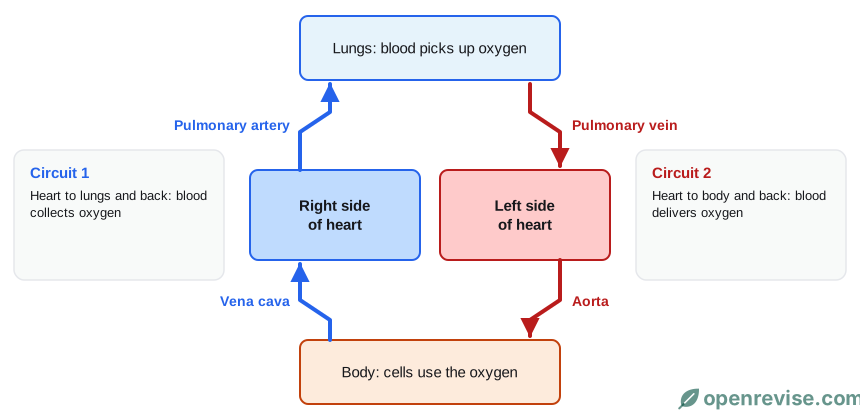
The structure of the heart
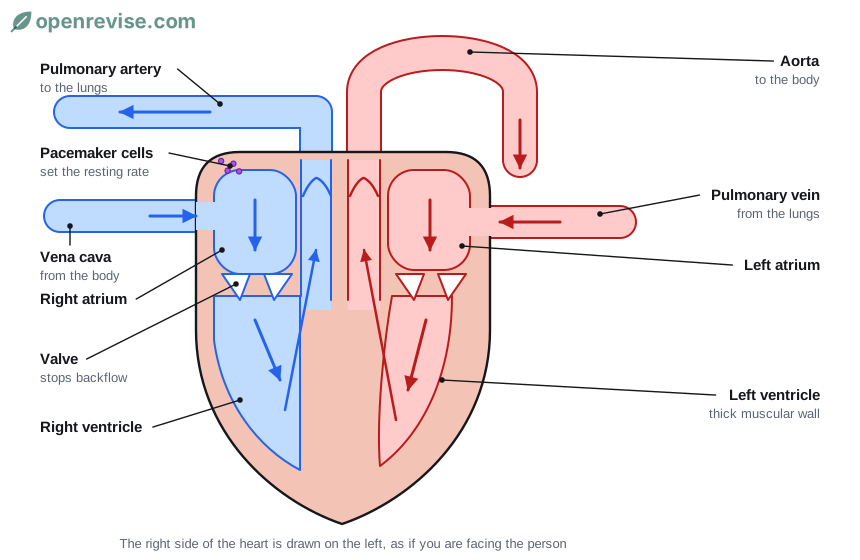
- Deoxygenated blood from the body enters the right atrium through the vena cava.
- The atria contract and push blood into the ventricles.
- The right ventricle contracts and pumps blood through the pulmonary artery to the lungs.
- Oxygenated blood returns from the lungs through the pulmonary vein into the left atrium.
- The left ventricle contracts and pumps blood through the aorta to the rest of the body.
Valves between the atria and ventricles, and at the start of the arteries, close to stop blood flowing backwards.
Structure and function
- The left ventricle has a much thicker muscle wall than the right. It must pump blood at high pressure all the way round the body, while the right ventricle only pumps blood to the lungs, which are close by.
- The heart muscle needs its own supply of oxygen and glucose for respiration. This comes from the coronary arteries, which branch off the aorta and run over the surface of the heart.
The pacemaker
The natural resting heart rate is controlled by a group of cells in the right atrium that act as a pacemaker, sending out small electrical impulses that make the heart muscle contract. If they stop working properly, an artificial pacemaker can be fitted: a small electrical device that corrects an irregular heart rate.
Test yourself on this lesson
7 exam questions · 16 marks · with mark schemes and model answers
Found a mistake?