2.10 Nanoparticles
The size of nanoparticles compared with atoms and fine and coarse particles, why their high surface area to volume ratio gives them different properties, their uses, and their possible risks.
How small?
Key terms
- Nanoparticle: a particle 1 to 100 nm across, containing a few hundred atoms.
- Nanoscience: the study of structures that are 1 to 100 nm in size.
1 nm = 1 × 10⁻⁹ m (one billionth of a metre). An atom is about 0.1 nm across, so nanoparticles are roughly 10 to 1000 times bigger than atoms.
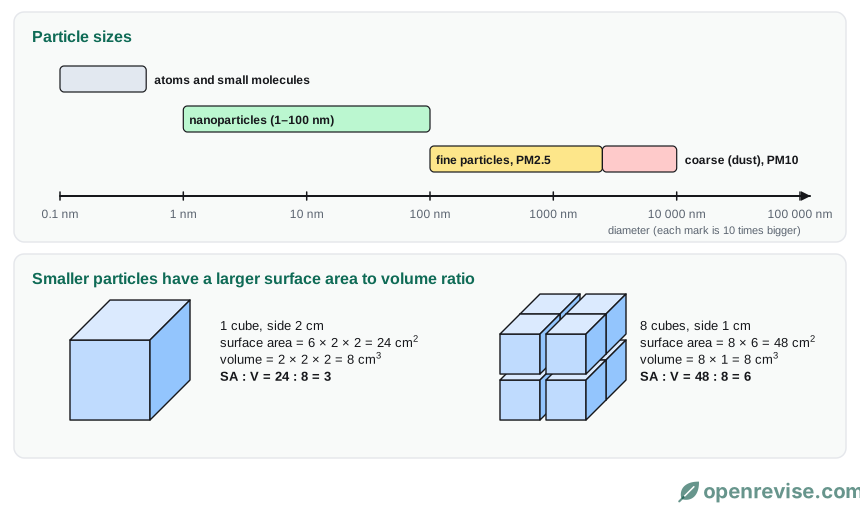
| Particle | Diameter |
|---|---|
| Atom | about 0.1 nm |
| Nanoparticle | 1 to 100 nm |
| Fine particle (PM2.5) | 100 to 2500 nm (1 × 10⁻⁷ to 2.5 × 10⁻⁶ m) |
| Coarse particle, dust (PM10) | 2500 to 10 000 nm (2.5 × 10⁻⁶ to 1 × 10⁻⁵ m) |
Surface area to volume ratio
When a particle is made smaller, its surface area to volume ratio increases. For a cube, if the side decreases by a factor of 10, the surface area to volume ratio increases by a factor of 10.
Nanoparticles have a very high surface area to volume ratio, so a large proportion of their atoms are on the surface. This means:
- their properties differ from the same material in bulk (larger pieces)
- smaller quantities may be needed, for example of a catalyst
Uses
- Sun creams: nanoparticles of titanium dioxide or zinc oxide block UV light but are transparent on the skin.
- Catalysts: a huge surface area for reactions.
- Medicine: delivering drugs to particular cells.
- Electronics: tiny, conducting components.
- Cosmetics, deodorants and fabrics: silver nanoparticles kill bacteria.
Possible risks
- Nanoparticles may be breathed in or absorbed through the skin and enter cells and the bloodstream.
- They may damage cells or be toxic, and could harm the environment when washed away.
- Their long-term effects are not yet known, because they are a new technology. More research is needed.
Test yourself on this lesson
5 exam questions · 10 marks · with mark schemes and model answers
Found a mistake?