4.5 Acids, alkalis and the pH scale
What makes a solution acidic or alkaline, the pH scale from 0 to 14, measuring pH with universal indicator or a pH probe, and the colours of common indicators.
AQA
Edexcel
OCR
1 min read
Acids and alkalis
Key terms
- Acid: a substance that produces hydrogen ions, \mathrm{H^+}, when dissolved in water.
- Base: a substance that neutralises an acid, such as a metal oxide, hydroxide or carbonate.
- Alkali: a base that dissolves in water. Alkalis produce hydroxide ions, \mathrm{OH^-}, in solution.
Common acids: hydrochloric acid (HCl), sulfuric acid (H2SO4), nitric acid (HNO3). Common alkalis: sodium hydroxide (NaOH), potassium hydroxide (KOH), calcium hydroxide (Ca(OH)2), ammonia solution.
The pH scale
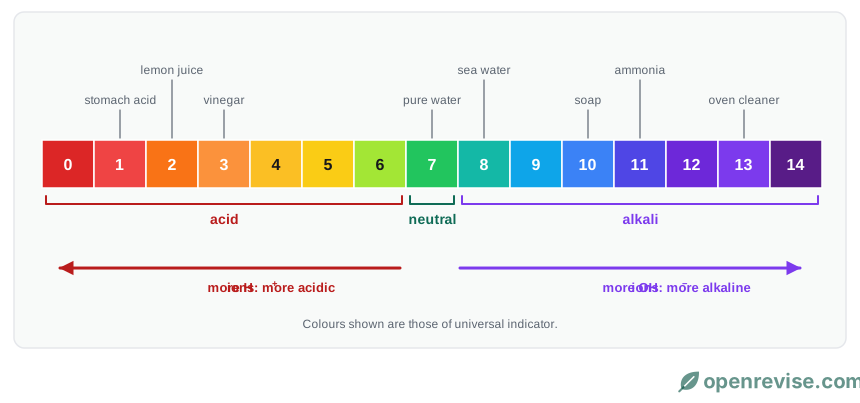
- pH below 7: acidic. The lower the pH, the more acidic (more \mathrm{H^+} ions).
- pH 7: neutral, such as pure water.
- pH above 7: alkaline. The higher the pH, the more alkaline (more \mathrm{OH^-} ions).
Measuring pH
- Universal indicator (paper or solution): compare the colour with a chart. Quick, but only gives an approximate whole-number pH, and depends on judging a colour.
- pH probe and meter: gives an accurate reading, often to one or two decimal places.
Other indicators
Single indicators only show whether a solution is acidic or alkaline, by a sudden colour change.
| Indicator | In acid | In alkali |
|---|---|---|
| Litmus | red | blue |
| Methyl orange | red | yellow |
| Phenolphthalein | colourless | pink |
Methyl orange and phenolphthalein are used in titrations, because they change colour sharply.
Test yourself on this lesson
5 exam questions · 8 marks · with mark schemes and model answers
Found a mistake?