3.2 Relative formula mass and percentage by mass
How to calculate the relative formula mass of a substance from relative atomic masses, including formulae with brackets, and how to calculate the percentage by mass of an element in a compound.
Relative formula mass
Key terms
- Relative atomic mass (A_\mathrm{r}): the average mass of an atom of an element compared with carbon-12. It is the larger number in each box of the periodic table.
- Relative formula mass (M_\mathrm{r}): the sum of the relative atomic masses of all the atoms in a formula.
To find M_\mathrm{r}, add up the A_\mathrm{r} of every atom in the formula. M_\mathrm{r} has no units.
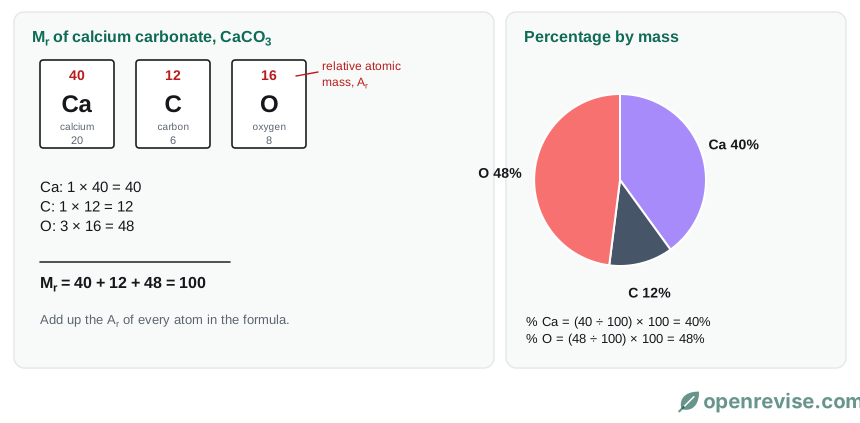
Examples (A_\mathrm{r}: H = 1, C = 12, N = 14, O = 16, Mg = 24, S = 32, Ca = 40):
- H2O = (2 × 1) + 16 = 18
- CO2 = 12 + (2 × 16) = 44
- CaCO3 = 40 + 12 + (3 × 16) = 100
Brackets: multiply everything inside the bracket by the number outside.
- Mg(OH)2 = 24 + 2 × (16 + 1) = 24 + 34 = 58
- (NH4)2SO4 = 2 × (14 + 4) + 32 + (4 × 16) = 36 + 32 + 64 = 132
In a balanced equation, the total M_\mathrm{r} of the reactants equals the total M_\mathrm{r} of the products, because mass is conserved:
2Mg + O2 → 2MgO: (2 × 24) + 32 = 80 and 2 × 40 = 80
Percentage by mass of an element
Example 1: percentage of calcium in CaCO3 = (40 × 1) ÷ 100 × 100 = 40%
Example 2: percentage of nitrogen in ammonium nitrate, NH4NO3 (M_\mathrm{r} = 80):
(14 × 2) ÷ 80 × 100 = 28 ÷ 80 × 100 = 35%
Test yourself on this lesson
5 exam questions · 11 marks · with mark schemes and model answers
Found a mistake?