1.16 Equivalent fractions, simplifying and ordering fractions
Equivalent fractions, simplifying a fraction by dividing by the highest common factor, changing between improper fractions and mixed numbers, and ordering fractions using a common denominator or decimals.
What is a fraction?
Key terms
- Fraction: a number that represents part of a whole, written as a numerator over a denominator.
- Numerator: the top number of a fraction. It shows how many parts are taken.
- Denominator: the bottom number. It shows how many equal parts the whole is split into.
- Equivalent fractions: fractions that have the same value, such as \frac{1}{2}, \frac{2}{4} and \frac{4}{8}.
- Simplest form: a fraction that cannot be cancelled any further because the numerator and denominator have no common factor except 1.
A fraction such as \frac{3}{5} means 3 parts out of 5 equal parts. The denominator (5) says how many equal parts, and the numerator (3) says how many are being counted. A fraction is also a division: \frac{3}{5} = 3 \div 5 = 0.6.
Equivalent fractions
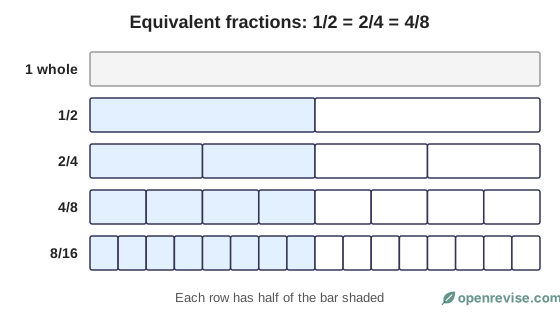
The same amount can be written in many ways. In the fraction wall, half of the bar is shaded in each row, even though the bar is cut into 2, 4 or 8 pieces. To make an equivalent fraction, multiply (or divide) the numerator and denominator by the same number.
\dfrac{3}{5} = \dfrac{3 \times 3}{5 \times 3} = \dfrac{9}{15} and \dfrac{3}{5} = \dfrac{6}{10} = \dfrac{12}{20}.
This works because multiplying top and bottom by the same number is the same as multiplying the fraction by 1, so its value does not change.
Worked example. Find the missing numbers: \dfrac{5}{8} = \dfrac{?}{24} = \dfrac{35}{?}.
To go from 8 to 24, multiply by 3, so the numerator is 5 \times 3 = 15. To go from 5 to 35, multiply by 7, so the denominator is 8 \times 7 = 56. So \dfrac{5}{8} = \dfrac{15}{24} = \dfrac{35}{56}.
Simplifying fractions
To simplify (or cancel) a fraction, divide the numerator and the denominator by a common factor. To simplify fully in one step, divide by the highest common factor (HCF).
Worked example. Simplify \dfrac{18}{24}.
The HCF of 18 and 24 is 6. \dfrac{18 \div 6}{24 \div 6} = \dfrac{3}{4}. Check that 3 and 4 have no common factor except 1.
Worked example. Simplify \dfrac{56}{84}. The HCF is 28, so the answer is \dfrac{2}{3}. If you did not spot 28, you could divide by 4 to get \dfrac{14}{21}, and then by 7 to get \dfrac{2}{3}.
Worked example. In a class of 30 students, 18 walk to school. What fraction walk? \dfrac{18}{30} = \dfrac{3}{5}.
Improper fractions and mixed numbers
A fraction with a numerator bigger than the denominator is an improper (top-heavy) fraction. A mixed number has a whole number part and a fraction part. You must be able to change from one to the other.
- Improper to mixed: divide the numerator by the denominator. \dfrac{17}{5}: 17 \div 5 = 3 remainder 2, so \dfrac{17}{5} = 3\dfrac{2}{5}.
- Mixed to improper: multiply the whole number by the denominator and add the numerator. 4\dfrac{3}{8} = \dfrac{4 \times 8 + 3}{8} = \dfrac{35}{8}.
Ordering fractions
Method 1: common denominator. Change the fractions so they have the same denominator, then compare the numerators. Use the lowest common multiple of the denominators.
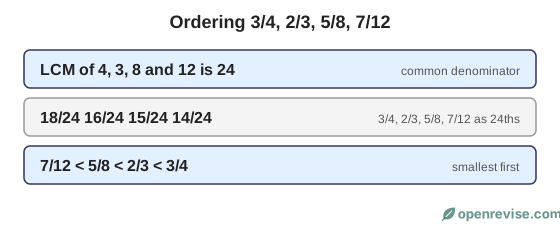
Worked example. Put \dfrac{3}{4}, \dfrac{2}{3}, \dfrac{5}{8} and \dfrac{7}{12} in order, smallest first.
The LCM of 4, 3, 8 and 12 is 24. Then \dfrac{3}{4} = \dfrac{18}{24}, \dfrac{2}{3} = \dfrac{16}{24}, \dfrac{5}{8} = \dfrac{15}{24} and \dfrac{7}{12} = \dfrac{14}{24}. In order: \dfrac{7}{12}, \dfrac{5}{8}, \dfrac{2}{3}, \dfrac{3}{4}.
Method 2: decimals. Divide the numerator by the denominator: 0.75, 0.667, 0.625 and 0.583. This gives the same order.
Comparing two fractions quickly. To compare \dfrac{3}{7} and \dfrac{5}{11}, cross-multiply: 3 \times 11 = 33 and 5 \times 7 = 35. Since 33 < 35, \dfrac{3}{7} < \dfrac{5}{11}.
Negative fractions. For negative fractions the order reverses. To order -\dfrac{1}{2}, -\dfrac{2}{3} and -\dfrac{3}{8}, compare the positive sizes (0.5, 0.667, 0.375): the largest negative number is the one with the smallest size. So smallest first: -\dfrac{2}{3}, -\dfrac{1}{2}, -\dfrac{3}{8}.
Fractions and decimals you should know
| Fraction | Decimal | Fraction | Decimal |
|---|---|---|---|
| \frac{1}{2} | 0.5 | \frac{1}{8} | 0.125 |
| \frac{1}{4} | 0.25 | \frac{3}{8} | 0.375 |
| \frac{3}{4} | 0.75 | \frac{1}{5} | 0.2 |
| \frac{1}{10} | 0.1 | \frac{1}{3} | 0.333... |
Exam-style example
Question. Amir says, '\frac{3}{8} is greater than \frac{1}{2} because 8 is greater than 2.' Is Amir correct? You must show your working.
Answer. No. Write \frac{1}{2} with denominator 8: \frac{1}{2} = \frac{4}{8}. Since \frac{3}{8} < \frac{4}{8}, \frac{3}{8} is less than \frac{1}{2}. (As decimals, 0.375 < 0.5.) A bigger denominator means smaller pieces, not a bigger fraction.
Common mistakes
- Adding the same number to the top and bottom: \frac{2}{3} \ne \frac{5}{6}. You must multiply or divide.
- Believing that a bigger denominator makes a bigger fraction.
- Not simplifying fully, for example stopping at \frac{6}{8} instead of \frac{3}{4}.
- Making errors converting mixed numbers: 4\frac{3}{8} is not \frac{43}{8}.
Fractions on a number line
Every fraction has a place on the number line between 0 and 1 (if it is a proper fraction) or beyond 1 (if it is improper). Equivalent fractions mark the same point. To place \frac{3}{4} on a line from 0 to 1, split the line into 4 equal parts and mark the third mark. The number line also shows why \frac{6}{8} is the same point: split the line into 8 parts and mark the sixth mark, and the two marks coincide. Showing fractions on a number line is a good way to check an ordering, because the fraction further to the right is the larger.
A step-by-step method for ordering mixed fractions
- If the fractions are mixed numbers, compare the whole numbers first: 3\frac{1}{4} is bigger than 2\frac{7}{8}.
- For fractions with the same whole number, compare the fraction parts using a common denominator.
- Change improper fractions to mixed numbers or decimals so they are easier to compare.
- For negative fractions, compare the sizes ignoring the signs, then reverse the order.
- Write the final answer in the original form of the fractions, not in the common denominator form, unless the question asks for it.
Fractions in everyday life
We use fractions all the time without noticing: a recipe that needs \frac{3}{4} cup of flour, a pizza cut into 8 slices where you eat \frac{3}{8} of it, a test score of 18 out of 24 (\frac{18}{24} = \frac{3}{4}), or a discount of \frac{1}{5} off the price. Being able to simplify and compare fractions helps you to understand quantities quickly. If two shops offer \frac{2}{5} off and \frac{3}{8} off, the common denominator 40 gives \frac{16}{40} and \frac{15}{40}, so \frac{2}{5} is the bigger discount.
Summary
- Make equivalent fractions by multiplying or dividing the top and bottom by the same number.
- Simplify by dividing by the HCF.
- To order fractions, use a common denominator (the LCM) or decimals.
- Convert carefully between improper fractions and mixed numbers.
Test yourself on this lesson
9 exam questions · 19 marks · with mark schemes and model answers
Found a mistake?