1.17 Adding and subtracting fractions
Adding and subtracting proper fractions, improper fractions and mixed numbers using a common denominator, including negative fractions and problems set in context.
Adding and subtracting fractions
Key terms
- Common denominator: a denominator that is a multiple of the denominators of the fractions being added or subtracted.
- Lowest common multiple (LCM): the smallest number that is a multiple of two or more numbers. It gives the simplest common denominator.
- Mixed number: a number with a whole part and a fraction part, such as 2\frac{1}{3}.
- Improper fraction: a fraction where the numerator is larger than the denominator, such as \frac{7}{3}.
You can only add or subtract fractions when the pieces are the same size. If the denominators are the same, you simply add or subtract the numerators and keep the denominator. If the denominators are different, you must first change the fractions into equivalent fractions that share a common denominator.
Same denominators
When the denominators match, add or subtract the numerators only. The denominator names the size of the pieces and does not change.
\dfrac{3}{8} + \dfrac{2}{8} = \dfrac{5}{8} and \dfrac{7}{10} - \dfrac{3}{10} = \dfrac{4}{10} = \dfrac{2}{5}.
Different denominators
Method:
- Find the LCM of the denominators. This is the common denominator.
- Write each fraction as an equivalent fraction with that denominator.
- Add or subtract the numerators.
- Simplify the answer, and convert to a mixed number if it is improper.
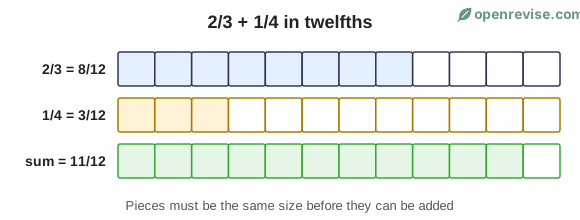
Worked example. Work out \dfrac{2}{3} + \dfrac{1}{4}.
The LCM of 3 and 4 is 12. \dfrac{2}{3} = \dfrac{8}{12} and \dfrac{1}{4} = \dfrac{3}{12}. So \dfrac{8}{12} + \dfrac{3}{12} = \dfrac{11}{12}.
Worked example. Work out \dfrac{5}{6} - \dfrac{3}{8}.
The LCM of 6 and 8 is 24. \dfrac{5}{6} = \dfrac{20}{24} and \dfrac{3}{8} = \dfrac{9}{24}. So \dfrac{20}{24} - \dfrac{9}{24} = \dfrac{11}{24}.
Worked example. Work out \dfrac{3}{4} + \dfrac{5}{6}.
The LCM of 4 and 6 is 12. \dfrac{3}{4} = \dfrac{9}{12} and \dfrac{5}{6} = \dfrac{10}{12}, so the sum is \dfrac{19}{12} = 1\dfrac{7}{12}. The answer is bigger than 1, so it is an improper fraction that you convert to a mixed number.
Mixed numbers
There are two methods.
Method 1: whole numbers and fractions separately. Add the whole numbers, then add the fractions, then combine.
Worked example. Work out 2\dfrac{1}{3} + 1\dfrac{3}{4}.
Whole numbers: 2 + 1 = 3. Fractions: \dfrac{1}{3} + \dfrac{3}{4} = \dfrac{4}{12} + \dfrac{9}{12} = \dfrac{13}{12} = 1\dfrac{1}{12}. Total: 3 + 1\dfrac{1}{12} = 4\dfrac{1}{12}.
Method 2: change to improper fractions. This is the safest method for subtraction.
Worked example. Work out 3\dfrac{1}{4} - 1\dfrac{2}{3}.
3\dfrac{1}{4} = \dfrac{13}{4} and 1\dfrac{2}{3} = \dfrac{5}{3}. Common denominator 12: \dfrac{39}{12} - \dfrac{20}{12} = \dfrac{19}{12} = 1\dfrac{7}{12}.
Negative fractions
The rules for negative numbers still apply. Find a common denominator first, then work out the numerators as signed numbers.
Worked example. Work out -\dfrac{1}{2} + \dfrac{1}{3}. -\dfrac{3}{6} + \dfrac{2}{6} = -\dfrac{1}{6}.
Worked example. Work out \dfrac{2}{5} - \dfrac{3}{4}. \dfrac{8}{20} - \dfrac{15}{20} = -\dfrac{7}{20}.
Fraction problems
Worked example. Sam eats \dfrac{1}{3} of a pizza and Tia eats \dfrac{1}{4} of it. What fraction is left?
Eaten: \dfrac{1}{3} + \dfrac{1}{4} = \dfrac{4}{12} + \dfrac{3}{12} = \dfrac{7}{12}. Left: 1 - \dfrac{7}{12} = \dfrac{12}{12} - \dfrac{7}{12} = \dfrac{5}{12}. Remember that the whole is 1, which can be written with any denominator.
Worked example. A tank is \dfrac{3}{8} full. The tank's total capacity is 80 litres. A further \dfrac{1}{4} of the tank is filled, and then \dfrac{1}{2} of the tank is emptied. How much water is in the tank now?
\dfrac{3}{8} + \dfrac{1}{4} = \dfrac{3}{8} + \dfrac{2}{8} = \dfrac{5}{8}. Then \dfrac{5}{8} - \dfrac{1}{2} = \dfrac{5}{8} - \dfrac{4}{8} = \dfrac{1}{8}. So the tank holds \dfrac{1}{8} \times 80 = 10 litres.
Common mistakes
- Adding the denominators as well as the numerators: \dfrac{1}{2} + \dfrac{1}{3} \ne \dfrac{2}{5}. The correct answer is \dfrac{5}{6}.
- Changing the denominator but not the numerator when making equivalent fractions.
- Forgetting to simplify, or leaving the answer as an improper fraction when a mixed number is asked for.
- Subtracting the smaller whole number from the larger without considering the fractions in mixed number subtraction.
Checking your answer by estimating
After you add or subtract fractions, decide whether the answer is sensible. Round each fraction to the nearest half or whole. For \frac{3}{4} + \frac{5}{6}, both fractions are a bit under 1, so the total should be a bit under 2: the answer 1\frac{7}{12} fits. For 3\frac{1}{4} - 1\frac{2}{3}, the estimate is 3 - 2 = 1 or a little more, which agrees with 1\frac{7}{12}. An answer such as 4\frac{1}{12} would show that you had made a mistake.
Why we need a common denominator
Imagine adding 2 thirds and 1 quarter. A third and a quarter are different-sized pieces, so the 2 and the 1 cannot just be added: it is like adding 2 metres and 1 foot without converting. Cutting every piece into twelfths makes them all the same size: 2 thirds are 8 twelfths and 1 quarter is 3 twelfths, so the total is 11 twelfths. The denominator tells you the size of the pieces, and the numerator tells you how many. We only add the numerators because we only add how many pieces we have once they are all the same size.
Fractions in context
Fractions of a whole appear in many real problems: the fraction of a journey completed in two stages, the fraction of a budget spent on different items, or the fraction of a tank filled by different pipes. In such problems the whole is always 1 (or \frac{12}{12}, \frac{24}{24}, and so on). To find the fraction that is left, subtract the fractions used from 1. To find a total amount, convert the final fraction back to a quantity by multiplying: \frac{1}{8} of 80 litres is 80 \div 8 = 10 litres.
Summary
- Fractions can only be added or subtracted when they have a common denominator.
- Use the LCM of the denominators, make equivalent fractions, then add or subtract the numerators.
- For mixed numbers, use whole numbers and fractions separately, or change to improper fractions.
- Keep the answer in simplest form.
Test yourself on this lesson
9 exam questions · 23 marks · with mark schemes and model answers
Found a mistake?