1.25 Error intervals and truncation
Using inequality notation to give the error interval for a number that has been rounded or truncated, the difference between rounding and truncating, and applying limits of accuracy to decide whether an object fits a space.
Rounded values hide the exact value
Key terms
- Error interval: the range of values that a rounded or truncated number could have been before it was rounded.
- Truncation: cutting off the digits after a given place without rounding.
- Limits of accuracy: the smallest and largest values a measurement could really be.
- Inequality: a statement using <, \le, > or \ge to show a range of values.
When a number has been rounded, we no longer know its exact value. If the length of a pencil is 14 cm to the nearest centimetre, its real length could be 13.6 cm or 14.4 cm, or any value in between. The set of all possible values is called the error interval. We write it using an inequality.
Finding an error interval for a rounded number
The rule is: half a unit either side of the rounded value, where the unit is the place value you rounded to.
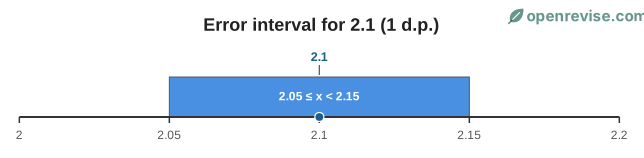
Worked example. The number x = 2.1 is rounded to 1 decimal place. Write down the error interval.
The unit is 0.1, so half a unit is 0.05. The lowest value that rounds to 2.1 is 2.1 - 0.05 = 2.05, and the values up to just below 2.1 + 0.05 = 2.15 also round to 2.1. So 2.05 \le x < 2.15.
Notice the signs. The lower bound is included (\le), because 2.05 rounds up to 2.1. The upper bound is not included (<), because 2.15 rounds up to 2.2.
Worked example. A number is 350, correct to the nearest 10. The unit is 10 and half a unit is 5, so 345 \le x < 355.
Worked example. A number is 0.8, correct to 1 significant figure. The 8 is in the tenths column, so the unit is 0.1 and the error interval is 0.75 \le y < 0.85.
Worked example. A number is 4000 correct to 1 significant figure. The 4 is in the thousands column, so the unit is 1000 and half a unit is 500: 3500 \le n < 4500.
Worked example. A length is 12.5 cm to 3 significant figures. The last significant figure is in the tenths, so half a unit is 0.05: 12.45 \le L < 12.55.
Truncation
Truncating a number means chopping off the digits after a place, with no rounding. The truncated value is always less than or equal to the original number (for positive numbers).
| Method | What happens | Result |
|---|---|---|
| Rounding | the decider 8 is 5 or more, so round up | 3.8 |
| Truncating | cut off after the first decimal place | 3.7 |
For a truncated number, the error interval goes from the truncated value up to the next unit, not half a unit either side.
Worked example. A number x = 2.1 is truncated to 1 decimal place. Any number from 2.1 up to (but not including) 2.2 truncates to 2.1, so 2.1 \le x < 2.2.
Counting numbers
If the quantity is a count, such as the number of cars, then only whole numbers are possible. If 200 cars is correct to the nearest hundred, 150 \le n < 250 as for any measurement, but because n must be a whole number we can also write 150 \le n \le 249.
Limits of accuracy in problems
You can use error intervals to decide whether something is certain to happen, or only possible.
Worked example. A box has a width of 20 cm, to the nearest centimetre. A shelf has a width of 22 cm, to the nearest centimetre. Can you be sure that the box fits on the shelf?
The box is less than 20.5 cm wide. The shelf is at least 21.5 cm wide. Since 20.5 < 21.5, the box always fits.
Worked example. The box is 20 cm and the shelf is 20 cm, both to the nearest centimetre. The box could be as wide as 20.4 cm and the shelf could be as narrow as 19.5 cm. So you cannot be sure the box fits.
Exam-style example
Question. (a) The length of a rod is 8.4 m, correct to 1 decimal place. Write down the error interval. (b) A different number is 8.4 when truncated to 1 decimal place. Write down its error interval.
Answer. (a) 8.35 \le L < 8.45. (b) 8.4 \le x < 8.5.
Common mistakes
- Using the whole unit instead of half a unit: for 2.1 to 1 d.p. writing 2.0 \le x \le 2.2.
- Using \le at both ends. The upper limit is not included, so it must be <.
- Forgetting that truncation goes up to the next unit and does not use half a unit.
- Getting the size of the unit wrong for significant figures.
Summary
- A rounded number could be half a unit above or below its stated value.
- The error interval is \text{lower bound} \le x < \text{upper bound}.
- Truncating goes up to the next unit, with no half unit.
- Use error intervals to decide whether something is certain or only possible.
Test yourself on this lesson
9 exam questions · 18 marks · with mark schemes and model answers
Found a mistake?