1.24 Rounding to decimal places and significant figures
Rounding to a stated number of decimal places or significant figures, rounding to the nearest 10, 100 or 1000, rounding sensibly in context, and not rounding during intermediate steps of a calculation.
What is rounding?
Key terms
- Rounding: replacing a number with a simpler number that is close to it.
- Decimal place (d.p.): the position of a digit after the decimal point. The first decimal place is the tenths column.
- Significant figure (s.f.): a digit that carries meaning, counted from the first non-zero digit.
- Degree of accuracy: how precisely a number is given, for example 2 decimal places or 3 significant figures.
We round numbers so that they are easier to use and to show how accurate a value is. A calculator answer such as 18.1438295 has far more digits than is sensible if the measurements were only given to 2 digits. The question will say how to round: to the nearest 10, to 2 decimal places or to 3 significant figures.
The rounding rule
- Find the digit in the position you are rounding to.
- Look at the next digit to the right (the decider).
- If the decider is 5 or more, round up (add 1 to the digit). If the decider is 4 or less, keep the digit the same.
- Drop all the digits after the rounded digit (replace them with zeros if they are before the decimal point).
Rounding to the nearest 10, 100 or 1000
Worked example. Round 4857 to the nearest 100. The hundreds digit is 8 and the decider (the tens digit) is 5, so round up: 4900.
Worked example. Round 3649 to the nearest 10. The tens digit is 4 and the decider is 9, so round up to 3650.
Decimal places
Count the places after the decimal point.
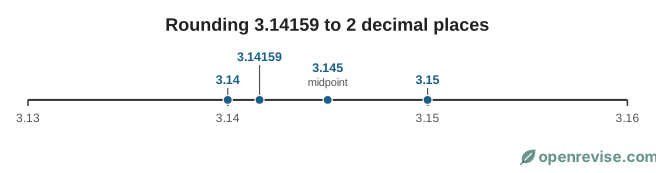
Worked example. Round 3.14159 to 2 decimal places. The second decimal place is 4 and the decider is 1, so it stays: 3.14. The number line shows why: 3.14159 is nearer to 3.14 than to 3.15, because the midpoint is 3.145.
Worked example. Round 0.0678 to 2 decimal places. The second decimal place is 6 and the decider is 7, so round up: 0.07.
Worked example. Round 2.996 to 2 decimal places. The decider is 6, so round up. The 9 becomes 10, which carries: 2.996 rounds to 3.00. You must write the zeros: 3.00 shows that the answer is correct to 2 decimal places, but 3 does not.
Significant figures
The first significant figure is the first digit that is not zero. From then on, every digit counts, including zeros between or after other digits. Zeros at the start of a number (leading zeros) are only place holders and are not significant.
| Number | First significant figure | Rounded to 2 s.f. |
|---|---|---|
| 0.004 567 | 4 (the third decimal place) | 0.0046 |
| 40 593 | 4 (the ten-thousands) | 41 000 |
| 7.0486 | 7 | 7.0 |
| 0.0305 | 3 | 0.031 |
Worked example. Round 0.004567 to 2 significant figures. The first significant figure is 4, the second is 5 and the decider is 6, so round up: 0.0046.
Worked example. Round 40 593 to 2 significant figures. The first two significant figures are 4 and 0. The decider is 5, so round up: 41 000. The remaining digits become place-holder zeros.
Worked example. Round 7.0486 to 3 significant figures. The digits are 7, 0 and 4 and the decider is 8, so round up: 7.05.
Rounding calculator answers
Do not round during a calculation. If you round in the middle, the error can build up. Keep the full calculator value (or use the ANS key), and round only the final answer.
Worked example. Work out 7.3 \div 2.9 to 2 decimal places. The calculator shows 2.51724..., and the decider is 7, so the answer is 2.52.
Worked example. Work out 5.67 \times 3.2 to 1 decimal place. 5.67 \times 3.2 = 18.144, and the decider is 4, so the answer is 18.1.
Rounding in context
Sometimes you must round up or down because of the situation, even if the rounding rule says otherwise.
- A coach holds 52 passengers. For 230 students you need 230 \div 52 = 4.42... coaches. You cannot have part of a coach, so round up to 5.
- Money is rounded to 2 decimal places (the nearest penny).
- If you can make 6.8 cakes from a recipe, you can make only 6 complete cakes: round down.
Exam-style example
Question. Work out the value of \dfrac{3.84 + 2.17}{0.0312}. Give your answer to 3 significant figures.
Answer. The top is 3.84 + 2.17 = 6.01. Then 6.01 \div 0.0312 = 192.628.... The decider after the third significant figure (2) is 6, so round up: 193. Notice that the intermediate value 6.01 was not rounded, and the final answer is given to the accuracy asked for.
Common mistakes
- Counting significant figures from the decimal point, not from the first non-zero digit.
- Not writing trailing zeros, for example 2.996 to 2 d.p. is 3.00, not 3.
- Rounding too early in a calculation, or rounding twice.
- Dropping digits before the decimal point instead of replacing them with zeros: 40 593 to 2 s.f. is 41 000, not 41.
Summary
- Look at the decider digit: 5 or more rounds up, 4 or less stays.
- Decimal places are counted after the point; significant figures are counted from the first non-zero digit.
- Use place-holder zeros so the number keeps its size.
- Round only at the end of a calculation.
- In context, round up or down according to the situation.
Test yourself on this lesson
9 exam questions · 19 marks · with mark schemes and model answers
Found a mistake?