1.2 Calculating with integers and negative numbers
Formal written methods for adding, subtracting, multiplying and dividing whole numbers, and the rules for calculating with negative numbers, including problems in context. Most of this is tested without a calculator.
Written methods
Key terms
- Sum: the answer to an addition.
- Difference: the answer to a subtraction.
- Product: the answer to a multiplication.
- Quotient: the answer to a division.
- Remainder: the amount left over when a number does not divide exactly.
Calculating accurately without a calculator is an important skill and is tested on a non-calculator paper. Always set the working out clearly with the digits in their correct columns, and check your answer by estimating or by using the inverse operation.
Addition and subtraction
Line up the digits by place value (units under units, tens under tens), start at the right and carry any 10s you make when adding. When subtracting, exchange (borrow) from the next column when the top digit is smaller.
Worked example (addition). Work out 4786 + 2539.
Units: 6 + 9 = 15, write 5 and carry 1. Tens: 8 + 3 + 1 = 12, write 2 and carry 1. Hundreds: 7 + 5 + 1 = 13, write 3 and carry 1. Thousands: 4 + 2 + 1 = 7. The answer is 7325.
Worked example (subtraction). Work out 6004 - 2678.
There are zeros in the tens and hundreds columns, so exchange from the thousands: 6004 becomes 5 thousands, 9 hundreds, 9 tens and 14 units. Then 14 - 8 = 6, 9 - 7 = 2, 9 - 6 = 3, 5 - 2 = 3. The answer is 3326. Check: 3326 + 2678 = 6004.
Multiplication
For a number times a two-digit number, use long multiplication or the grid method. Multiply by the units digit, then by the tens digit (put a zero in the units column as a place holder), then add.
Worked example. Work out 34 \times 26.
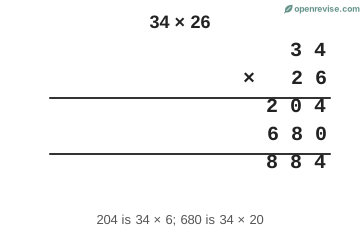
34 \times 6 = 204 and 34 \times 20 = 680, so 204 + 680 = 884.
Division
Short division (the bus stop method) works for dividing by a small number. Long division is used for larger divisors.
Worked example (short division). Work out 1476 \div 4.
4 into 14 goes 3 remainder 2; 4 into 27 goes 6 remainder 3; 4 into 36 goes 9. The answer is 369.
Worked example (long division). Work out 3432 \div 12.
12 into 34 goes 2 (24), remainder 10; bring down the 3: 12 into 103 goes 8 (96), remainder 7; bring down the 2: 12 into 72 goes 6. The answer is 286. Check: 286 \times 12 = 3432.
If a division does not come out exactly, give the remainder: 507 \div 8 = 63 remainder 3.
Negative numbers
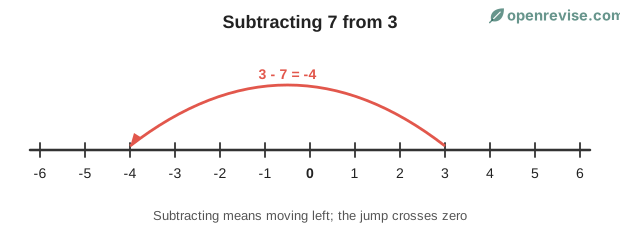
Use a number line to add and subtract negative numbers: add means move right, subtract means move left.
| Calculation | Same as | Example | Answer |
|---|---|---|---|
| a + (-b) | a - b | 5 + (-2) | 3 |
| a - (-b) | a + b | 5 - (-3) | 8 |
| -a - b | -(a + b) | -4 - 6 | -10 |
| -a + b | b - a | -7 + 10 | 3 |
Subtracting a negative number is the same as adding a positive number. For example, -8 - (-3) = -8 + 3 = -5.
| Signs | Result | Example |
|---|---|---|
| Same signs (+ and + or - and -) | Positive | (-2) \times (-5) = 10 |
| Different signs (+ and - or - and +) | Negative | -6 \times 4 = -24 |
| Dividing follows the same rules | -36 \div (-9) = 4 |
With several multiplications, count the negatives: an even number of negative signs gives a positive answer. (-2) \times (-5) \times (-3) = 10 \times (-3) = -30.
Problems in context
Worked example. A diver is at a depth of -18 m. She rises 7 m and then dives 12 m. Where is she now?
-18 + 7 = -11 and -11 - 12 = -23, so she is at -23 m.
Worked example. A coach costs £252 to hire for a trip and 28 students share the cost equally. Each student also pays £18 for entry. Work out what each student pays in total.
252 \div 28 = 9, so the coach costs £9 each, and 9 + 18 = £27.
Checking your answers
Always check a written calculation. There are two quick methods.
- Estimate by rounding each number to one significant figure. For 47 \times 38 the estimate is 50 \times 40 = 2000, which is close to the exact answer of 1786. An exact answer of 17 860 or 178.6 would be obviously wrong.
- Use the inverse operation. For 3326 + 2678 = 6004 you can check 6004 - 2678 = 3326. For a division, multiply the answer by the divisor.
Exam-style example
Question. A theatre has 38 rows with 24 seats in each row. 29 seats are not for sale. How many seats are for sale? Each ticket costs £15. Work out the most money the theatre can take from one show.
Working. Total seats: 38 \times 24 = 912 (since 38 \times 20 = 760 and 38 \times 4 = 152, and 760 + 152 = 912). Seats for sale: 912 - 29 = 883. Money: 883 \times 15 = 8830 + 4415 = 13\,245, which is £13 245. (Here 883 \times 10 = 8830 and 883 \times 5 = 4415.)
Notice the layout: each step is on its own line, the units are written at the end, and the answer is sensible when you estimate: 900 \times 15 = 13\,500.
Negative numbers in real life
Negative numbers appear in temperatures, bank balances, floors of a building below ground and heights below sea level. In a bank statement a negative balance means you owe money. If an account is at -£45 and £120 is paid in, the new balance is -45 + 120 = £75. If a further £90 is spent, the balance becomes 75 - 90 = -£15. In temperature questions, the difference between two temperatures is the higher temperature minus the lower: from -7 °C to 4 °C is 4 - (-7) = 11 degrees.
Summary
- Set out column methods carefully, with digits in the correct columns.
- Check with an estimate or the inverse operation.
- Subtracting a negative is the same as adding the positive.
- Same signs when multiplying or dividing give a positive answer; different signs give a negative answer.
- Give the answer in context, with the correct units.
Test yourself on this lesson
9 exam questions · 21 marks · with mark schemes and model answers
Found a mistake?